A Dendera Temple trip from Hurghada is one of those journeys that leaves many Egypt fans asking the same question afterwards:
Why did I not know about this place before?
Almost everyone has seen pictures of the pyramids.
Karnak appears in nearly every Luxor itinerary.
The Valley of the Kings is often part of a first trip to Egypt.
Dendera and Abydos usually come later, perhaps on a second or third visit.
That is surprising.
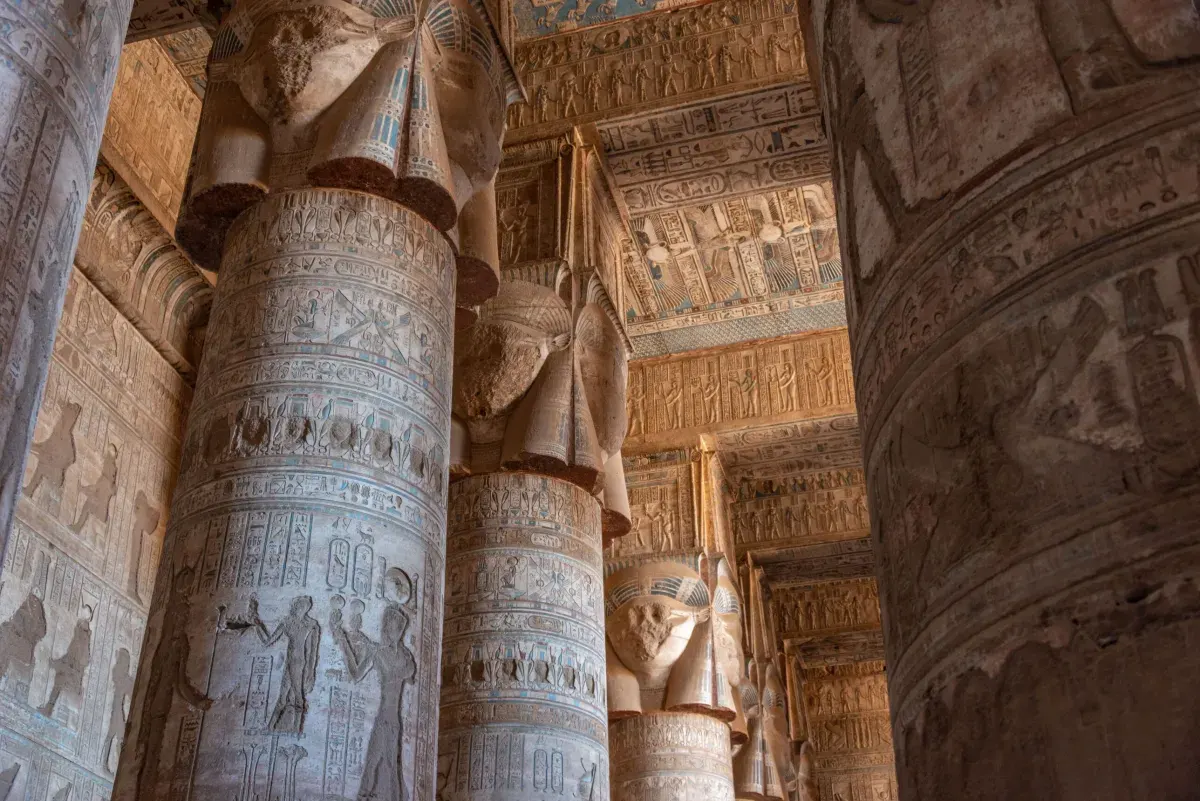
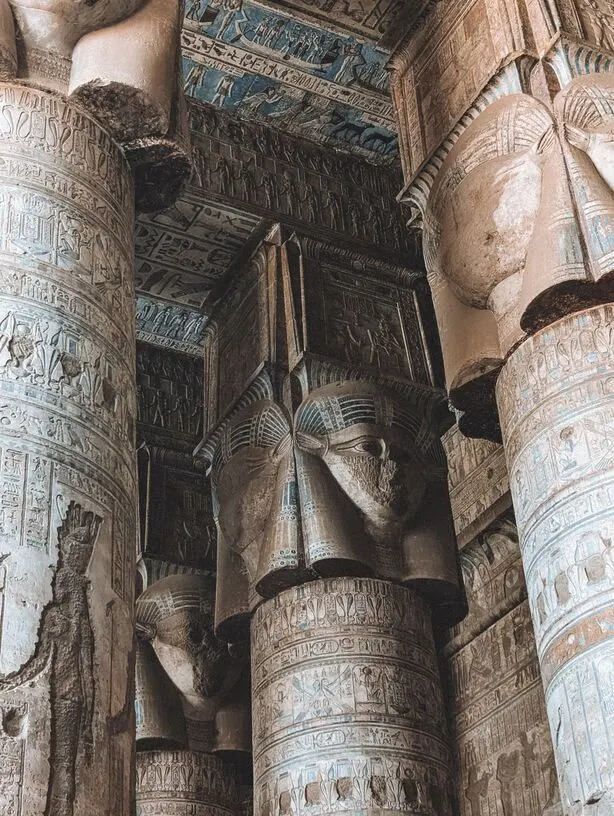
Inside the Temple of Hathor at Dendera, blue ceilings, stars, astronomical scenes and detailed reliefs still survive. Huge columns carry capitals decorated with the face of the goddess Hathor. You can walk through rooms where much more colour remains than many travellers expect after seeing temples such as Karnak.
Then comes Abydos.
The Abydos Temple of Seti I is one of Egypt’s most important temples for art and history. Some of its reliefs are so finely carved that they look more like drawings than stonework. Add the famous Abydos King List, seven sanctuaries and the temple’s deep connection with Osiris, and this becomes much more than another stop on a temple route.
Dendera and Abydos are not substitutes for Luxor.
They are not places you visit only because you have already “done Karnak”.
They show different sides of ancient Egypt.
Dendera takes you into the Ptolemaic and Roman periods, when Egyptian religion continued long after the great pharaohs of the New Kingdom.
Abydos takes you into the New Kingdom while also connecting you with a sacred site that had already mattered for thousands of years.
Egypt’s Ministry of Tourism and Antiquities describes the Temple of Hathor at Dendera as one of the best-preserved temples in Egypt. The main temple visible today dates mainly from the Ptolemaic period, while religious activity at the site reaches much further back.
Abydos was connected with kingship, burial and the cult of Osiris for a very long time. Archaeological work there has found royal activity going back to Egypt’s earliest dynasties.
If you want a private cultural trip from Hurghada that goes well beyond the standard first-time itinerary, Dendera and Abydos deserve a very high place on your list.
Why Dendera Is a Real Hidden Gem from Hurghada
The phrase “hidden gem” gets used rather freely in travel writing.
Sometimes it describes a place with twelve tour coaches parked outside.
Dendera fits the description better.
The temple stands near Qena, north of Luxor, and appears far less often in standard Hurghada day trips than Karnak or the Valley of the Kings.
That does not mean you will have the place completely to yourself.
Dendera is well known.
Archaeologists know it.
Experienced Egypt travellers know it.
For the typical Hurghada visitor, though, it still stays under the radar.
That is part of its appeal.
You are not visiting a minor temple simply because fewer people know its name.
You are visiting one of Egypt’s best-preserved major temple complexes.
What Makes Dendera Temple So Special?
The main temple at Dendera was dedicated to Hathor.
Hathor was one of ancient Egypt’s most important goddesses.
She was connected with:
music,
joy,
dance,
motherhood,
love,
femininity,
and the sky.
Dendera was one of her major cult centres.
Even the façade already feels different from many other temples.
Six large columns dominate the entrance area. Their capitals show Hathor’s face, framed by elements connected with the sistrum, a musical instrument closely linked with her worship.
Then you walk inside.
And look up.
You will do that a lot in Dendera.
The Famous Blue Ceilings of Dendera
Many people imagine Egyptian temples as beige or grey stone.
Dendera shows how misleading that picture can be.
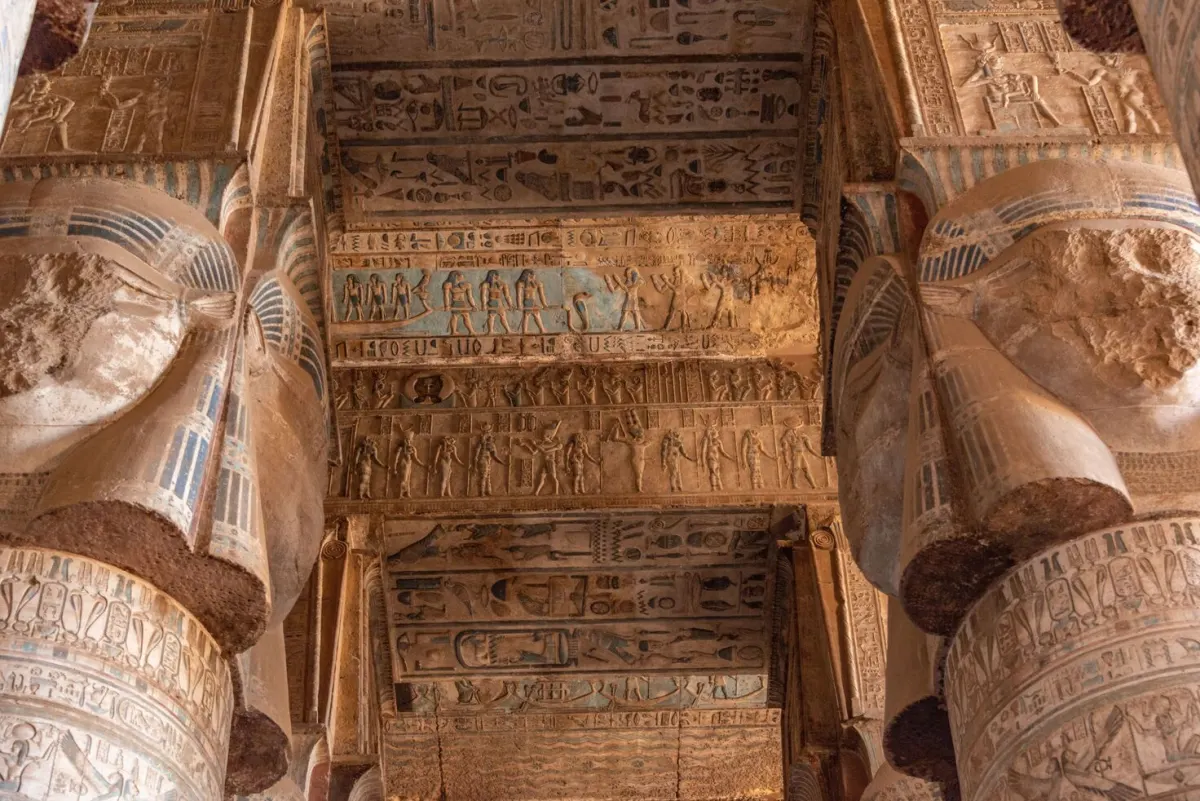
Large areas of colour survive on the ceilings, while restoration work has made some original pigments easier to see again.
Blue dominates many sections.
You can also find:
stars,
winged figures,
gods,
sky scenes,
solar boats,
astronomical symbols,
and long rows of hieroglyphs.
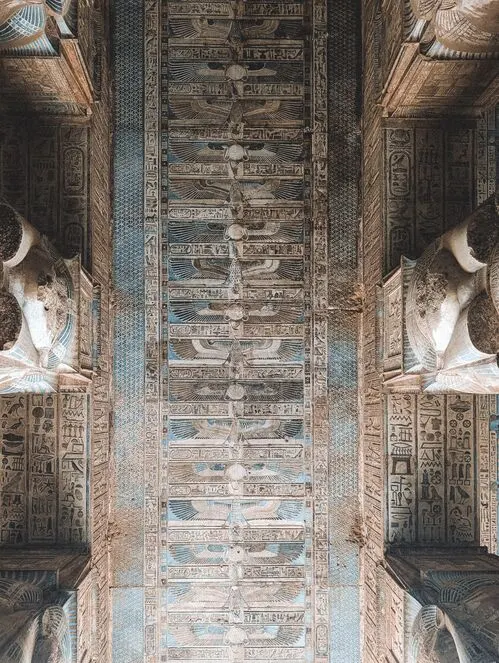
The astronomical ceiling scenes are among the best-known features of the temple.
If you enjoy photography, Dendera is one of the strongest temple visits in Upper Egypt.
You do not need specialist camera equipment.
A phone and a quiet moment are often enough because the architecture does most of the work for you.
Your neck may complain before your camera does.
After an hour in Dendera, you may have looked upwards more often than during the previous three weeks combined.
Why Are the Colours So Well Preserved?
Not every part of the temple is equally colourful.
And Dendera does not look exactly as it did two thousand years ago.
Still, protected interior surfaces have kept more pigment than many exposed outside walls.
Areas inside the temple were less affected by direct sun, wind and weather.
Modern conservation and cleaning have also removed dark deposits from some ceiling sections, making the original colours easier to see.
That is why Dendera rewards slow looking.
A relief that appears grey from a distance may reveal:
red,
blue,
green,
yellow,
and fine painted detail
when you move closer.
This is not a temple to rush through in twenty minutes.
The Hathor Columns: Four Faces Above You
The Hathor-headed columns are among the temple’s most recognisable features.
Hathor’s face appears on several sides of the capitals.
To modern visitors, they may look decorative.
Inside the temple, they were part of religious imagery.
Hathor was the Lady of Dendera.
Her presence was not limited to a statue inside one sanctuary.
The whole temple belonged to her divine world.
Standing among these columns helps you see how closely architecture, religion and art worked together in ancient Egypt.
The column, ceiling and wall were not separate design features.
They formed one visual and religious system.
The Crypts of Dendera
One feature that makes Dendera particularly unusual is its network of crypts.
Narrow spaces and corridors were built into thick temple walls and below certain sections.
They were probably used, among other things, to store valuable ritual objects and sacred equipment.
Some crypt areas may be available with an extra ticket.
Access can involve:
narrow passages,
low ceilings,
warm spaces,
and confined sections.
If you are comfortable with tight spaces, this can be one of the most memorable parts of the visit.
If you have strong claustrophobia, there is no reason to force yourself inside.
Dendera is worth visiting even without the crypts.
What About the Famous “Dendera Light Bulbs”?
Search for Dendera online and sooner or later you will find images from the crypts that some alternative theories describe as ancient electric lamps.
That is not the accepted archaeological interpretation.
Egyptologists read these scenes within the religious language of the temple, including imagery connected with the god Harsomtus and ideas of creation and renewal.
The reliefs are interesting enough without turning them into ancient electrical equipment.
If your guide shows you this scene, a much better question is:
Which gods and symbols are shown here?
That gets you much closer to the actual religious meaning than wondering where the extension cable was hidden.
The Dendera Zodiac: Famous but Often Misunderstood
Dendera is also known for its zodiac.
The so-called Dendera Zodiac originally came from an Osiris chapel in the upper part of the temple.
It combines Egyptian and Greco-Roman astronomical traditions.
There is one important detail for your visit:
The famous original is no longer in the temple.
It was taken to France in the nineteenth century and is now in the Louvre in Paris.
At Dendera, you see a copy in its original position.
That does not make the temple setting less interesting.
Quite the opposite.
In Paris, you see the original object.
In Dendera, you understand where it belonged.
Can You Go onto the Roof at Dendera?
Depending on current access rules, upper sections and panorama areas may be open with a separate ticket.
If access is available, it is worth considering.
From above, you get a better sense of:
the size of the complex,
the surrounding landscape,
the temple’s position near Qena,
and how the different sections fit together.
The roof also had religious importance.
Ancient Egyptian temple roofs were not simply empty spaces above the building.
Some rituals took place there deliberately, closer to the sky and sun.
Was Dendera Only One Temple?
No.
The wider complex contained much more than the main Temple of Hathor.
The site includes or once included:
smaller shrines,
birth houses,
a sacred lake,
additional buildings,
Roman and late-antique remains,
and a large enclosure wall.
This shows how long the site remained active.
Egyptian religion did not simply end when the last major native pharaoh disappeared.
The temple you see today was built during a period when Egypt was ruled first by the Ptolemies and later by the Romans.
The religious tradition still remained deeply Egyptian.
That is one of the reasons Dendera is so interesting.
Cleopatra at Dendera: Is She Really on the Wall?
Yes.
There are famous exterior reliefs showing Cleopatra VII and her son Caesarion.
That gives Dendera another layer for travellers interested in Egypt’s later history.
Cleopatra lived more than a thousand years after Ramesses II.
Yet she was still shown within traditional Egyptian temple imagery.
That tells you something important about how long this artistic and religious system survived.
If you know only the pyramids, Karnak and the Valley of the Kings, it is easy to think Egyptian temple culture belongs only to the great pharaohs.
Dendera shows otherwise.
The tradition lasted far longer.
Dendera or Karnak: Which Temple Is Better?
That is not a fair contest.
Karnak is enormous.
Its Hypostyle Hall is one of the most impressive architectural spaces in Egypt.
Dendera is smaller, more enclosed and far more colourful in many interiors.
Karnak impresses through scale.
Dendera impresses through detail.
Karnak feels:
monumental,
wide,
complex,
and built over many centuries.
Dendera feels:
more compact,
easier to understand,
more colourful,
and unusually complete inside.
For Egypt lovers, the best answer is not:
Karnak or Dendera?
It is:
Karnak and Dendera.
Then Comes Abydos – and the Journey Gets Even Better
Dendera alone would already make a strong cultural trip.
Abydos changes the character of the route again.
The Abydos Temple lies farther north in Sohag Governorate.
The best-known surviving temple there was begun by Seti I and later continued and decorated under Ramesses II and later rulers.
It is widely recognised for the quality of its reliefs, surviving colour, seven sanctuaries and the famous King List.
This is not a minor archaeological site.
Why Was Abydos So Important in Ancient Egypt?
Abydos was sacred long before Seti I built his temple.
Royal burials from Egypt’s earliest periods lie in the wider region.
Archaeological work in North Abydos has identified monuments from the First and Second Dynasties, linking the site with the early development of the Egyptian state.
Later, Abydos became one of the major cult centres of Osiris.
Osiris was closely connected with:
death,
the afterlife,
rebirth,
kingship,
and the hope of continued existence after death.
For many ancient Egyptians, Abydos became a place of religious pilgrimage.
Those who could not be buried there might still seek a symbolic connection with the site.
Stelae, chapels and pilgrimage traditions show how important Abydos remained for centuries.
The Temple of Seti I: Seven Sanctuaries Instead of One
The Temple of Seti I has an unusual plan.
Rather than a single main sanctuary, it contains seven parallel chapels.
They were dedicated to:
Osiris,
Isis,
Horus,
Amun-Re,
Re-Horakhty,
Ptah,
and Seti I himself.
This makes the temple feel different from many other Egyptian complexes.
You are not simply walking towards one central holy room.
Several sacred axes open beside one another.
Why Are the Reliefs at Abydos So Famous?
This is the main reason many Egyptologists and experienced travellers love Abydos.
The reliefs from the reign of Seti I are among the finest of the New Kingdom.
Figures are softly modelled.
Faces are carefully carved.
Clothing, crowns and body lines show a level of detail that you do not always find in later, faster-cut reliefs.
Some colour survives as well.
That makes Abydos ideal for travellers who genuinely want time to look at temple art.
Do not stay only in the middle of the room.
Move closer to the walls.
Look at:
hands,
faces,
wigs,
jewellery,
hieroglyphs,
and the way the figures meet the surrounding text.
You quickly notice how refined the carving is.
The Abydos King List
One of the most famous historical records in the temple is the Abydos King List.
It shows Seti I with his son Ramesses II before a long sequence of royal names.
For modern Egyptology, this list is valuable because it helps reconstruct the sequence of ancient Egyptian rulers.
It is not a complete and neutral database.
Certain rulers were deliberately left out.
Those omissions are part of what makes the list so interesting.
It does not only ask:
Who ruled Egypt?
It also asks:
Whom did Seti I want to remember – and whom did he choose to forget?
History was political even then.
Why Is Akhenaten Missing?
Akhenaten and several rulers connected with the Amarna period do not appear in the list.
This reflects the political and religious reaction that followed Akhenaten’s reign.
Akhenaten had promoted the Aten cult strongly while traditional religious institutions were pushed aside.
Later rulers restored the old cults.
Seti I presented himself as part of that restored traditional order.
The King List is therefore not a modern school chronology.
It is royal memory carved in stone.
The Osiris Scenes at Abydos
Abydos was deeply connected with Osiris.
That relationship runs through the temple.
Important reliefs show rituals and scenes connected with the god’s death, worship and rebirth.
If you have already visited the Valley of the Kings, this creates a useful connection.
There, you see texts and images dealing with the dead king’s journey through the next world.
At Abydos, you meet one of the main divine models for death and rebirth.
That is one reason Luxor and Abydos work so well together.
The Osireion: One of the Most Unusual Parts of Abydos
Behind the Temple of Seti I lies the Osireion.
Architecturally, it feels very different from the temple itself.
Large stone blocks, a lower construction level and water around parts of the monument have inspired many theories.
Mainstream archaeological interpretation connects the Osireion with Seti I, his mortuary cult and Osiris symbolism.
As with many unusual Egyptian monuments, the internet has produced plenty of alternative ideas.
They are not needed.
The real religious context is unusual enough.
Access and visibility can vary depending on conservation work, water levels and current site rules.
Your guide should check what is open on the day of your visit.
What About the “Helicopter Hieroglyphs” at Abydos?
Abydos has another image that has had an unexpectedly long life online.
Overlapping hieroglyphs are sometimes described as looking like:
a helicopter,
an aeroplane,
a submarine,
or another modern machine.
The explanation is far less dramatic and much more historically sensible.
Different royal inscriptions were recut and overlapped.
As parts of the stone surface changed or were lost, the combined shapes began to resemble modern objects to modern eyes.
Our brains are very good at seeing familiar shapes in accidental patterns.
It is the same reason you can look at a cloud and suddenly see a dog.
Abydos already has enough genuine historical surprises.
It does not need a New Kingdom attack helicopter.
Dendera and Abydos: Which Temple Has More Colour?
If you mainly want strong ceiling colour, Dendera probably wins.
Its blue astronomical ceilings are striking.
Abydos works differently.
Its strengths are:
fine reliefs,
surviving pigments,
elegant lines,
religious scenes,
and exceptional stone carving.
Dendera gives you the immediate visual impact.
Abydos rewards the second and third look.
Photographically, the two temples work perfectly together.
Why This Route Works So Well for Repeat Visitors
If this is your first trip to Egypt and you have only two culture days, you will probably prioritise:
Giza,
Luxor,
Karnak,
and the Valley of the Kings.
That makes sense.
Once you have already seen those places, your questions change.
You stop asking only:
“What are the famous sights?”
You start asking:
“What comes next?”
That is where Dendera and Abydos become particularly attractive.
They suit travellers who:
have already visited Luxor,
are deeply interested in history,
enjoy photography,
love temple art,
prefer quieter archaeological sites,
or want a more detailed private cultural journey.
Is Dendera Closer to Hurghada Than Luxor?
Dendera lies near Qena, north of Luxor.
From the Red Sea region, the route can be planned towards the Nile Valley without first travelling into central Luxor.
That makes Dendera more practical from Hurghada, Safaga, Makadi Bay or Soma Bay than many travellers realise.
A Dendera-only visit can therefore be planned more compactly than a full Luxor programme involving several East and West Bank sites.
Abydos lies farther north.
If you want to visit Dendera and Abydos together, do not underestimate the distance.
This is not a short half-day excursion.
Can You Visit Dendera and Abydos in One Day from Hurghada?
In theory, very long itineraries can be built.
The better question is:
Would you enjoy it?
Dendera needs time.
Abydos does too.
Then there are the long road sections.
If you force both temples into one very long day, the hidden-gem experience can quickly become a temple marathon.
Early start.
Hours in the vehicle.
Dendera.
More driving.
Abydos.
Hours back.
It can be done.
That does not automatically make it the best way to see them.
For travellers coming for history, art and photography, more time usually gives a better experience.
Why a Three-Day Tour with Luxor Makes Sense
A strong route combines:
Luxor,
Dendera,
and Abydos
over several days.
That spreads out the road time and stops you having to leave every temple with one eye on the clock.
This type of route works particularly well if you do not want to collect temples like boxes on a checklist.
You get time to notice differences.
Karnak feels different after Dendera.
Abydos shows another style of relief work again.
Three places.
Three different impressions.
What Might a Three-Day Route Look Like?
A private route can begin with Luxor.
The first day may include Karnak, lunch and an evening visit to Luxor Temple or time in the city.
The second day can focus on the West Bank, with sites such as the Valley of the Kings, Hatshepsut Temple, Medinet Habu or the Valley of the Queens, depending on the programme.
Then the route continues towards Abydos.
The third day can be used for Abydos and Dendera before returning to the Red Sea.
That order works well because Dendera and Abydos are treated as major visits, not quick extra stops added to an already packed Luxor day.
Why Private Travel Works Particularly Well on This Route
A good group tour can work perfectly well for famous sites such as Karnak.
Dendera and Abydos benefit particularly from private travel.
Why?
Because visitors often have very different interests.
One person wants twenty minutes photographing the ceiling.
Another wants to understand every chapel in Abydos.
Someone is interested in the King List.
Another wants to see the crypts.
In a large group, everyone needs to move at roughly the same pace.
Privately, the day can be weighted more towards your interests.
That does not mean unlimited time.
Opening hours and road distances still exist.
You simply have more influence over where your time goes.
Dendera Opening Hours and Tickets in 2026
Opening hours, ticket prices and access to special areas can change.
Before travelling, check the current official Egyptian monument information or ask your tour operator to confirm the latest conditions.
Special areas such as crypts or upper temple sections may require separate tickets.
Do not build your day around an old screenshot from a travel forum.
Abydos Opening Hours in 2026
The same applies to the Temple of Seti I at Abydos.
Check current opening hours and final-entry rules before the trip.
If you are travelling on a longer private route, your schedule should not depend on reaching Abydos five minutes before final admission.
This temple deserves much more than a sprint from the ticket office.
Best Time to Visit Dendera and Abydos
For long cultural trips through Upper Egypt, the cooler months are usually more comfortable.
Roughly October to April often works well for longer temple visits.
Summer is still possible.
Plan carefully:
start early,
drink regularly,
wear a hat,
choose light clothing,
use sun protection,
and take proper breaks.
Dendera has many interior spaces.
That helps.
Abydos also includes large indoor sections.
The drives and open areas can still be very hot.
What Should You Take?
For a longer cultural trip to Dendera and Abydos, pack:
passport or required travel documents,
water,
sun cream,
sunglasses,
hat,
comfortable shoes,
light clothing,
power bank,
camera or phone,
some cash,
personal medication,
and a light jacket during cooler winter mornings.
A phone with a good wide-angle camera is particularly useful in Dendera.
The ceilings are large.
Very large.
If your camera normally specialises in dinner portraits, it is about to have a busy day.
Is the Route Suitable for Children?
For older children who enjoy history, it can be excellent.
Dendera works particularly well visually:
colours,
stars,
giant columns,
crypts,
upper sections.
Abydos may need more explanation.
Its reliefs become much more interesting when a guide tells the stories in a way children can follow.
For younger children, the biggest challenge is often not the temples.
It is the distance.
A multi-day private route is usually easier than trying to fit both temples and many hours of driving into one very long day.
What About Limited Mobility?
Both temples contain many areas that are easier to visit than steep royal tombs.
There can still be:
steps,
uneven surfaces,
longer walking distances,
narrow crypts,
and possible rooftop access.
If mobility is limited, there is no need to visit every special section.
The main halls and reliefs already offer a great deal.
A private trip also makes it easier to decide:
which areas are suitable,
where breaks are needed,
and which optional sections should be skipped.
Best Photo Spots in Dendera
If photography is one of your main reasons for going, give yourself enough time.
Strong subjects include:
The Hathor Columns
Do not photograph only from directly in front.
Try symmetrical views along the column rows.
The Blue Ceilings
Wide angle works especially well here.
Watch for heavy distortion near the edges.
Hathor Faces
The capitals also work well for tighter detail shots.
Astronomical Scenes
A straight-up composition can be very effective.
Roof and Panorama Views
If open, these give a completely different view of the complex.
Best Photo Subjects in Abydos
Abydos needs less wide angle and more close attention.
Look for:
Seti I before the gods,
finely carved faces,
surviving colour,
the seven chapels,
the King List,
Osiris scenes,
and side lighting across the reliefs.
Sometimes a photograph of two hands and three hieroglyphs is stronger than a full-wall image.
That suits Abydos.
The temple lives in the details.
Dendera, Abydos or Luxor – Which Should You Choose?
If you have only one culture day from Hurghada and have never been to Luxor, I would usually choose Luxor first.
The Valley of the Kings and Karnak are among Egypt’s major historical experiences.
If you already know Luxor or have several culture days, Dendera becomes very attractive.
If you are particularly interested in religion, relief art and royal history, add Abydos.
A simple guide:
Choose Luxor if:
this is your first visit to Upper Egypt,
the Valley of the Kings is high on your list,
you have not yet seen Karnak.
Choose Dendera if:
you want exceptionally well-preserved temple interiors,
colour and photography matter to you,
Hathor and astronomy interest you.
Choose Abydos if:
Egyptian history is a major interest,
Seti I and Ramesses II interest you,
you want to see refined relief art,
Osiris and ancient sacred sites appeal to you.
Choose all three regions if:
you want to compare Egyptian temple history rather than simply collect famous names.
Is Dendera Really One of Egypt’s Best-Preserved Temples?
Yes.
That description is widely used by Egypt’s own antiquities authorities.
Calling it the single best-preserved temple in Egypt is harder to defend because Egypt has several exceptionally well-preserved temples, including Edfu.
Dendera does not need to win a ranking.
Its colours, crypts, rooftop chapels, Hathor columns and astronomical ceilings are already enough.
Why Does Abydos Often Feel Quieter Than Luxor?
Abydos is not part of the same classic route as Karnak and the Valley of the Kings.
That often makes it feel calmer.
Do not expect to be guaranteed complete solitude.
Visitor levels change.
Groups arrive.
Egyptian visitors come too.
The difference is that Abydos is not automatically included in every standard itinerary.
That can give you more time to stand in front of one relief without a large group moving through immediately behind you.
For photography and focused guiding, that is a real advantage.
Why Dendera and Abydos Are More Than “Instagram Temples”
The colours look excellent in photographs.
That is obvious.
If you visit only for the pictures, you miss half the experience.
Dendera tells stories about:
Hathor,
astronomy,
temple ritual,
Ptolemaic rulers,
Roman Egypt,
and the long survival of Egyptian religion.
Abydos tells stories about:
Egypt’s earliest kings,
Osiris,
Seti I,
Ramesses II,
religious memory,
and how rulers wanted history to be remembered.
The best photographs are the ones where you also know what you photographed.
That is where a good Egyptologist becomes valuable.
FAQ: Dendera Temple from Hurghada and Abydos
Where Is Dendera Temple?
Dendera lies near Qena in Upper Egypt, north of Luxor.
The Temple of Hathor is the main monument in the complex.
Who Was Dendera Temple Dedicated To?
The main temple was dedicated to Hathor.
She was connected with music, joy, motherhood, love and the sky.
How Old Is Dendera Temple?
The main temple visible today dates largely from the Ptolemaic period.
The sacred site itself is much older.
Is Dendera Really Colourful?
Yes.
Strong colour survives particularly on ceilings and in protected interior areas.
The astronomical scenes are among the highlights.
Where Is the Original Dendera Zodiac?
The original is now in the Louvre in Paris.
A copy remains at the original location in the temple.
Can You Visit the Dendera Crypts?
Some crypt sections may be open with an additional ticket.
Access rules can change, so check before travelling.
Who Built the Temple at Abydos?
The best-known surviving temple was begun by Seti I and later continued and decorated under Ramesses II and later rulers.
Why Is Abydos Important?
Abydos was important from Egypt’s earliest periods and later became a major cult centre of Osiris.
What Is the Abydos King List?
It is a sequence of royal names shown inside the Temple of Seti I.
It is one of the most important sources for reconstructing Egyptian royal chronology, although it deliberately leaves out certain rulers.
Can You Visit Dendera and Abydos from Hurghada?
Yes.
Because of the long distances, a private multi-day route is often more comfortable when you want to see both temples properly.
How Many Days Should You Allow?
Dendera alone can work as a dedicated excursion.
If you want to combine Dendera, Abydos and major Luxor sights, several days make the journey much more relaxed.
Are Dendera and Abydos Better Than Luxor?
No.
They are different.
Luxor has some of Egypt’s most famous monuments, including Karnak and the Valley of the Kings.
Dendera and Abydos add another layer to that history.
Final Thoughts: Why Dendera and Abydos Belong on Your Egypt List
A Dendera Temple trip from Hurghada is not a replacement for Luxor.
The Abydos Temple is not somewhere you visit only because you have already finished the pyramids and Karnak.
Both deserve their own journey.
Dendera shows a side of Egypt many first-time visitors do not expect.
Blue ceilings.
Astronomical scenes.
Hathor columns.
Crypts.
Rooftop chapels.
Ptolemaic and Roman rulers shown inside a religious tradition that had already existed for thousands of years.
Abydos feels quieter at first.
Then you look closer.
Seti I stands before the gods.
Colour remains on the stone.
The King List carries you through centuries of Egyptian rule.
Behind much of it stands Osiris and the idea of death and rebirth.
These two places work particularly well for travellers who have already seen the famous classics and now ask:
What else is there to discover in Egypt?
The answer is:
Quite a lot.
And Dendera and Abydos are two of the best places to start.
If all you want is one quick photograph, both temples are almost too good for that.
If you want time for art, history, religion and unusually well-preserved temple spaces, a private Luxor, Dendera and Abydos route can become one of the strongest cultural trips from Hurghada.
Sometimes the best experience is not where every tour coach goes first.
Sometimes it is beneath a deep-blue temple ceiling in Dendera.
Or in front of a 3,300-year-old relief at Abydos, when you suddenly realise you have been staring at the same wall for five minutes.
And you are still not finished.