Egyptologist Instead of Entertainer: Why the Guide Makes All the Difference on a Hurghada Tour Without Shopping Stops
A Hurghada tour without shopping stops does not begin with the vehicle, entrance ticket or lunch. It begins with the person guiding you through Karnak, the Valley of the Kings or the Pyramids. A good guide explains connections, answers questions and protects your limited sightseeing time. A poor tour structure can make even major monuments feel like boxes on a checklist. Before booking, it is therefore worth asking not only where the tour goes, but one more important question: Who will actually guide me there?
What a “Shopping Tour” in Egypt Really Means
“Shopping tour” is not an official term for excursions in Egypt.
Travellers tend to use phrases such as “sales tour” when a cultural day begins to feel partly like a retail event.
A typical example works like this:
The itinerary lists temples, tombs or museums. During the day, the group is also taken to an alabaster workshop, papyrus shop, perfume store or another retail location.
There may be a genuine demonstration of how something is made.
Some visitors enjoy this and choose to buy something.
The shop itself is not the issue.
The problem begins when the visit was not made clear before booking or feels compulsory once the tour has started.
Our detailed guide to a Luxor day trip with no shopping stops explains the practical difference between voluntary shopping and retail visits built into the sightseeing programme.
The useful question is not:
“Are there souvenir shops in Egypt?”
Of course there are.
The better question is:
“Will sightseeing time I have paid for be used for a sales visit that I did not ask for?”
Mass-Market Tour vs Private Tour with an Egyptologist
Not every group tour is poor, and not every private tour is automatically good.
The main differences usually come down to structure, group size and whose timetable the day has to follow.
Point | Larger Group Tour | Private Tour with Egyptologist |
|---|---|---|
Group size | shared group; ask for the exact maximum | your own travel party; check the permitted group size |
Guide’s language level | depends on guide and group setup | language can usually be agreed in advance |
Professional qualification | should be checked before booking | ask directly about licence and background |
Shopping stops | may form part of the itinerary | can be explicitly excluded |
Time at the sights | follows the group schedule | can be adapted more closely to your group |
Flexibility | generally limited | greater within opening hours and the itinerary |
Questions for the guide | guide time is shared | direct access to your guide |
Price | usually lower | usually higher |
For a wider comparison of the two formats, see our guide to a private Luxor trip from Hurghada.
A low-cost group excursion can be completely suitable if your priority is seeing the main sights and you are comfortable with a fixed schedule.
A private tour becomes more relevant when you want to ask detailed questions, set priorities or avoid planned retail stops.
Where the Hours Really Go
Figures need to be handled carefully here.
There is no reliable market-wide evidence supporting the idea that every mass-market excursion loses several hours to shops.
What can be found in specific publicly described programmes are individual retail stops lasting around 20 to 45 minutes.
That is a much more useful way to discuss the issue.
Part of the Day | Group Tour with Published Shopping Stop | Private Tour Without Planned Shopping Stops |
|---|---|---|
Outward and return journey | depends on destination | depends on destination |
Sightseeing | fixed group programme | booked private programme |
Lunch | follows group schedule | follows tour itinerary |
One documented retail stop | around 20–45 min in specific examples | 0 min planned |
Further retail stops | [CHECK: specific product] | 0 min planned when agreed |
Free time and flexible breaks | limited | easier to adapt |
The important number is not an exaggerated claim about losing half the day.
Even 30 or 45 minutes can matter.
In the Valley of the Kings, half an hour may allow you to look at a tomb more calmly.
At Karnak, it can mean more time discussing the Great Hypostyle Hall.
To understand how those minutes fit into the wider day, our guide to a day trip from Hurghada to Luxor looks at the journey, sightseeing programme and practical difference between coach and private travel.
On a long excursion, time itself is part of what you are paying for.
Tour Leader, Guide, Egyptologist: What Is the Difference?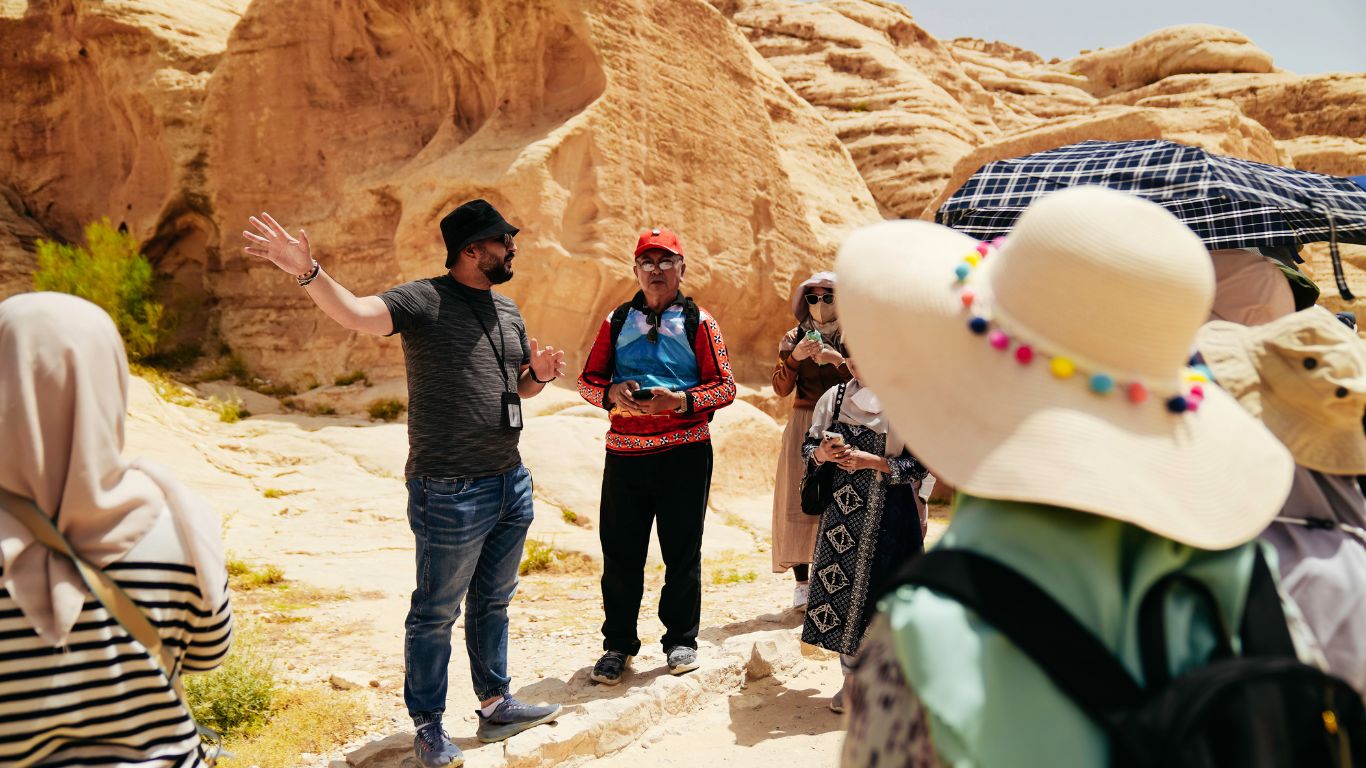
Travel websites often use these terms quite loosely.
“Guide”, “tour leader” and “Egyptologist” may sound similar, but they do not automatically describe the same education or professional role.
Professional tourist guiding in Egypt is regulated. The Egyptian Ministry of Tourism and Antiquities tourist-guide licensing service covers professional licences, licence renewal, examinations, training and the addition of foreign languages to guide licences.
Academic tourism-guidance programmes can also involve substantial subject training. The Department of Tourism Guidance at Misr University for Science & Technology describes study in Egyptian history, archaeology and culture, together with practical training in museums and tourism sites.
Still, the word “Egyptologist” should not be treated as a quality guarantee on its own.
Ask specific questions:
What education does the person have?
Are they licensed as a professional tourist guide?
Which language do they genuinely guide in?
Do they regularly guide at Luxor, Cairo or the destination you plan to visit?
Knowledge is not measured by how many dates someone can recite without stopping.
A strong Egyptologist can explain why a relief matters, how a temple relates to religion and politics, and why two apparently similar tombs may tell very different stories.
Why “German-Speaking” Does Not Always Mean the Same Thing
A “German-speaking guide” can mean several things.
Someone may speak enough German to explain meeting times, transport arrangements and basic facts.
That is different from holding a detailed conversation about Hatshepsut’s reign, the religious role of Karnak or the differences between Egypt’s Old and New Kingdoms.
For basic organisation, good everyday German may be enough.
A serious cultural tour demands more.
You may want to ask:
Why was this name removed?
Which parts are restored and which are original?
Why was this tomb built here?
Which old interpretation is no longer widely accepted?
That is when you notice whether the guide is repeating a memorised script or can genuinely respond to historical questions.
Do not therefore ask only:
“Is the guide German-speaking?”
Ask:
“Will the complete guided visit at the archaeological sites be conducted in German, and is the guide professionally qualified for those sites?”
That is a much more useful quality question.
Tipping, Commissions and Why Shopping Stops Exist
It helps to look at the economics calmly.
Very cheap excursions still have to operate as businesses.
The vehicle costs money.
Fuel costs money.
The driver costs money.
Organisation and guiding cost money.
Depending on the package, entrance tickets and meals may also be included.
In some tour models, commercial stops can provide an additional source of revenue.
A shop benefits from receiving potential customers, and commercial arrangements may exist between shops, intermediaries, operators or other participants.
From the outside, it is usually impossible to verify exactly what commission is paid in an individual case or who receives it.
[CHECK: reliable information about a specific commission model if independently verifiable data becomes available.]
It would therefore be unfair to assume automatically that every guide who visits a workshop is personally trying to profit from guests.
The stop may simply be part of the operator’s itinerary.
A much better question is:
“Are shopping, factory or retail stops included in the programme I am booking?”
Tipping is separate.
Our guide to tipping in Egypt explains how baksheesh works for guides, drivers, hotels and other everyday situations.
A tip is a voluntary way to recognise service.
It should not be confused with a planned commercial stop.
Checklist: 10 Questions to Ask Any Tour Provider Before Booking
These questions work regardless of which company you are considering:
Is the tour private, or will I share the vehicle and guide with other guests?
What is the maximum group size?
Who guides me at the archaeological sites: a tour escort, licensed guide or Egyptologist?
Is the complete guided visit conducted in German?
Are papyrus, perfume, alabaster, carpet or other shopping stops planned?
Can I explicitly exclude those stops before booking?
Which sights and entrance tickets are included in the price?
Roughly how much time is planned for the main sites?
Can the sightseeing pace be adjusted during the day?
Which costs may be added to the advertised price?
If a provider gives vague answers to straightforward questions, that is already useful information.
A serious tour company does not always have to give you the answer you hoped for.
It should be able to explain clearly what you are buying.
What a Private Tour Costs More – and What You Receive in Return
A private excursion will usually cost more than a larger group tour.
That is not a hidden disadvantage.
It is a straightforward result of the cost structure.
One vehicle, one driver and one guide are shared between fewer guests rather than a full group.
The additional cost can make sense when you genuinely value what it buys:
more direct access to the guide,
less group-related waiting,
more adaptable breaks,
your own priorities,
and a clearly agreed itinerary.
It makes less sense if those things are not important to you.
If your main aim is simply to reach Luxor at the lowest practical cost, see the main monuments and return to your hotel that evening, a well-run group excursion may be completely satisfactory.
This is also where Orient Discovery’s own approach becomes relevant.
The company currently states that it has a German office in Düsseldorf with local support in Hurghada, 17 years of experience and more than 3,000 personally guided tours. Its website also positions its cultural products around licensed German- and English-speaking guides and no planned shopping stops.
Even then, German-speaking travellers should ask the same questions they would ask any other provider:
Who will my guide be, what qualification do they have, and will my specific tour be fully conducted in German?
A serious consultation should not treat those questions as mistrust.
They are part of making a sound travel decision.
FAQ
What Does “Hurghada Tour Without Shopping Stops” Mean?
It means there are no planned visits to papyrus shops, perfume stores, alabaster workshops or similar retail locations as part of the booked cultural programme.
You can still choose to shop if you want to.
Are Shopping Stops Included on All Cheap Egypt Excursions?
No.
That cannot reasonably be said about the whole market.
Some itineraries include commercial stops, while others do not. Ask the provider directly before booking.
What Is the Difference Between a Guide and an Egyptologist?
The terminology is used differently in tourism marketing. What matters is education, professional licensing, subject knowledge and experience at the destination. Egypt has an official licensing system for professional tourist guides.
How Can I Recognise a Good German-Speaking Guide in Egypt?
Ask whether the entire guided visit will take place in German and who will provide it. Good language ability should be strong enough for spontaneous historical questions, not only a memorised standard explanation.
Is a Private Tour Always Better Than a Group Excursion?
No.
Group tours are generally cheaper and can be very well organised. A private tour is most useful for travellers who value flexibility, individual explanations and less group-related waiting.
How Much Time Is Lost to Shopping Stops?
There is no reliable universal figure. In specific publicly described Luxor products, individual commercial stops can be around 20 to 45 minutes. The actual itinerary needs to be checked for the exact product you are considering.
Should I Get Written Confirmation That There Are No Shopping Stops?
Yes, if this matters to you.
A written itinerary or booking description is clearer than an assumption and makes it easier to understand what your day is supposed to include.
A good cultural excursion does not need a guide whose main job is to keep everybody loudly entertained.
It needs someone who knows when to explain, when to answer and when to let you simply look.
If that is what you are looking for, you can discuss your preferred language, sights and travel style with Orient Discovery before booking.
[Request Free Advice for a Private Cultural Tour from Hurghada]