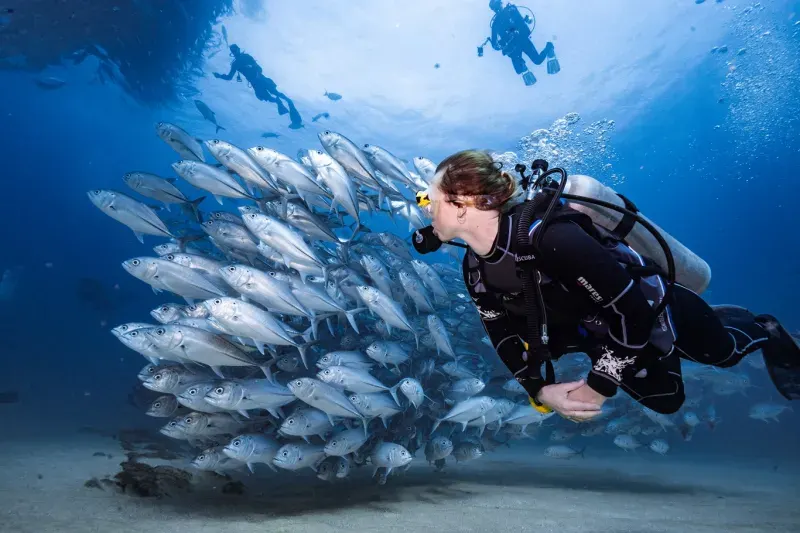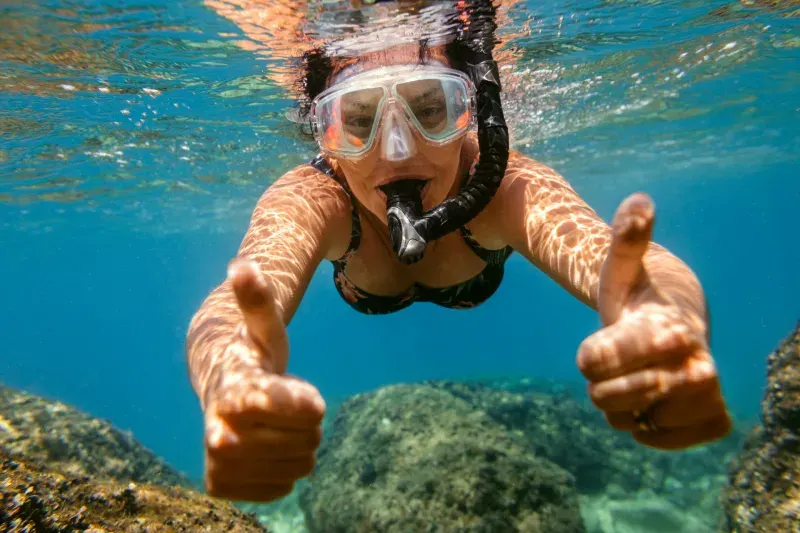
Let's be honest: breathing underwater is a deeply unnatural thing to do. Your brain has spent your whole life filing "water in face" under "emergency", and now you're on a boat in the Red Sea, in a wetsuit that seems to have been designed by someone who has never met a human body, being asked to calmly inhale through a plastic mouthpiece. Totally normal to feel a flutter of nerves.
The good news? Millions of people have done exactly this, and the vast majority come back up grinning like they've just discovered a secret. Hurghada is one of the best places on the planet to be a first-timer: warm water, gentle shallow reefs, sheltered sites and ridiculous visibility. This guide walks you through what an introductory dive actually involves, so the only surprises on the day are the nice ones (hello, clownfish).
What is an "intro dive", exactly?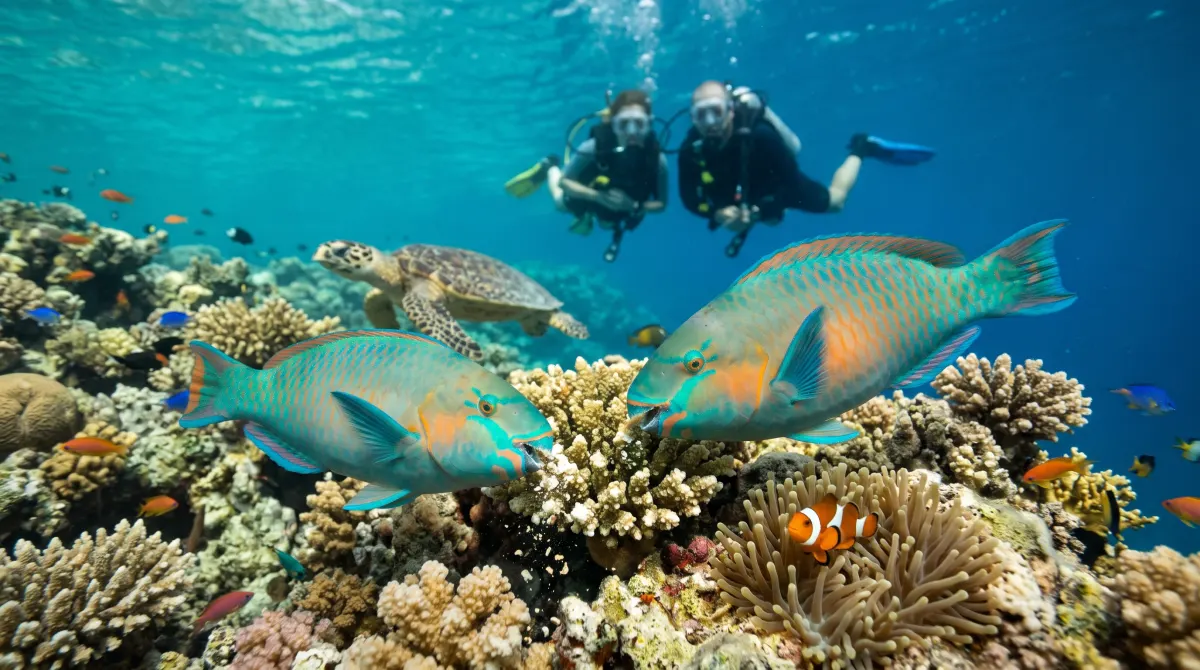
An intro dive (the Germans call it Schnuppertauchen, which sounds much cuter) is a supervised first taste of scuba diving. You don't need any certification, any previous experience or any superhuman lung capacity. You simply need to be in reasonable health, be able to swim a little, and be willing to listen to your instructor for ten minutes.
The best-known version is the PADI Discover Scuba Diving programme. According to PADI, it is open to anyone aged 10 or over, has no course prerequisites, and keeps you at shallow depths: up to 6 metres (20 feet) in the confined-water session, and up to 12 metres (40 feet) for an optional open-water dive. You'll need a basic level of health and fitness, and certain conditions, medications or recent surgery may require a doctor's approval first (PADI, "Discover Scuba Diving: About the Course"). In other words, nobody is dropping you off a cliff on day one.
Crucially, an intro dive is not a certification course. You'll dive with a professional instructor who stays right next to you the whole time, checks your equipment, controls your depth and handles the clever technical bits. Your job is the easy part: breathe, relax and look at fish.
Why Hurghada is a brilliant place to start
Hurghada has been Egypt's dive capital for decades, and there's a reason beginners keep coming back. The Red Sea is warm for most of the year, which means you won't spend your first dive shivering and wondering why you paid for this. The water is famously clear, so even at five or six metres you can see everything around you without any murky "where did my instructor go" moments. And the reefs here start shallow, which is exactly what a first-timer needs: lots of colour, lots of life, very little depth.
You'll typically see parrotfish crunching on coral (yes, you can hear them), shoals of tiny, shimmering anthias, angelfish, butterflyfish, the occasional curious moray peeking out of a crevice and, if the sea gods smile, a turtle gliding past like it has somewhere important to be. If you've snorkelled before and thought "this is lovely, but I'd like to be down there with them", an intro dive is precisely that upgrade.
A typical intro dive day, step by step
Every dive centre runs things slightly differently, but a well-organised intro dive day in Hurghada generally looks like this.
The pickup. You're collected from your hotel in Hurghada, El Gouna, Makadi Bay, Sahl Hasheesh or Soma Bay at an agreed time, so you aren't standing in the lobby wondering whether anyone is coming. A good operator gives you an exact pickup time the day before, not a vague "sometime in the morning".
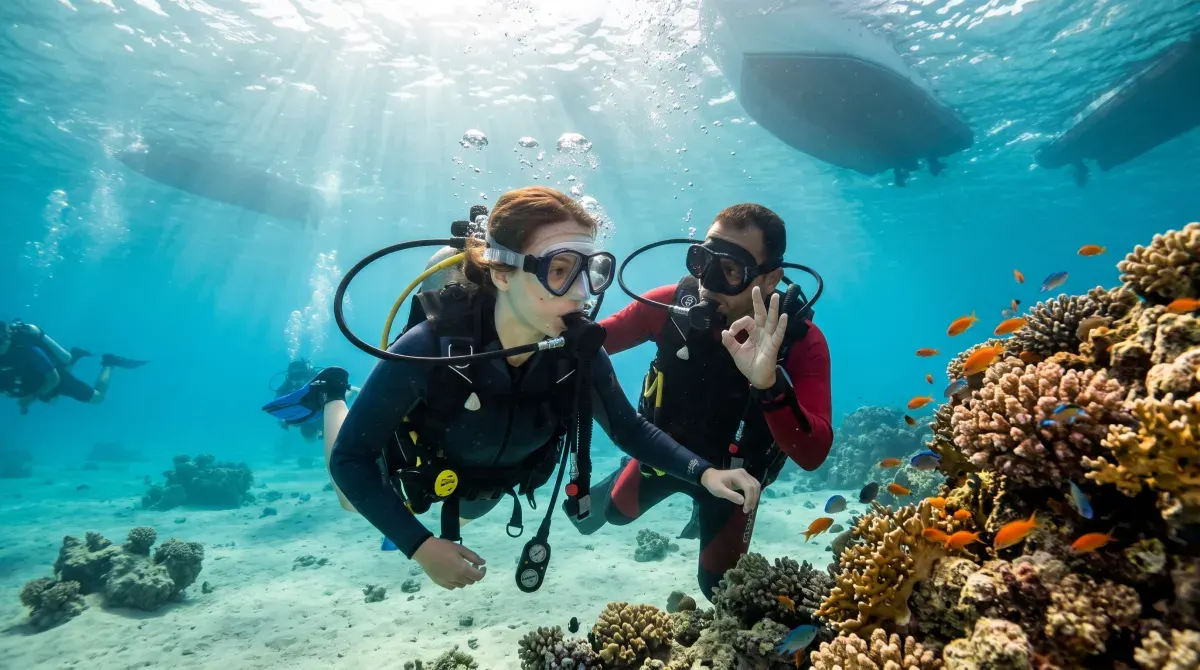
The briefing. Before you get anywhere near the water, your instructor explains the basics: how to breathe through the regulator, how to equalise the pressure in your ears (pinch your nose and gently blow, like you're trying not to sneeze), and a handful of hand signals, such as "OK", "up", "problem" and "look at that!". It takes minutes and it's much less scary than it sounds. You'll also fill in a short medical questionnaire, so answer it truthfully; the doctor's note is far less embarrassing than a medical emergency.
Kitting up. You'll be given a wetsuit, mask, fins, a buoyancy jacket and a tank, all fitted by the crew. Don't worry about looking glamorous. Nobody does in a wetsuit. It's like a great leveller, but with neoprene.
The first breaths. You'll practise breathing underwater in very shallow water, with your instructor right beside you, until it feels comfortable. This is usually the moment people have their little revelation: "Oh. I can actually do this." It's a rather lovely feeling.
The dive itself. Then you drift off along the reef, holding your instructor's hand or the buoyancy jacket if you like, kicking gently and pointing at things. Most intro dives last around 20 to 25 minutes underwater. That sounds short, but time behaves strangely down there, and most people are amazed when the instructor signals it's time to head back up.
The break. Between dives you relax on deck, warm up, chat about what you saw and eat lunch. A good boat day involves shade, drinks and proper food, not a sad sandwich.
What does an intro dive in Hurghada cost?
Prices vary widely depending on the boat, group size and what's included. As a reference, our own introductory dive day costs €65 per person and includes a full day on the boat with two dives, all the diving equipment, lunch and drinks on board, and transfers within Hurghada. Minimum age is 10, and no previous experience is needed. You can browse our current water-based excursions in the Snorkelling & Diving in Hurghada category.
When you compare prices anywhere, check the small print, because the cheap headline price is rarely the final one. Ask specifically whether these are included: equipment hire, lunch, drinks, hotel transfers, marine park fees and insurance. A "€30 intro dive" that turns into €70 once you add gear and transfers is not a bargain, it's a magic trick. If you want to know how to spot the other classic traps, have a read of our guide to tourist scams in Hurghada and how to avoid them.
Is it safe?
Scuba diving has a good safety record when done properly, which is exactly why the word "properly" matters so much. For an intro dive, safety comes from boring but important things: a qualified instructor, a small group, well-maintained equipment, shallow depths and an operator who actually checks your medical form.
Before you book anyone, ask three questions. First, how many people does each instructor look after? One-to-one or one-to-two is ideal. Second, who is the instructor and what are they certified with? Third, what happens if I feel anxious or uncomfortable mid-dive? A confident operator answers all of these without blinking. A vague one is telling you something.
It's also worth knowing the basics of travel safety in Egypt generally. UK travellers can check the latest official guidance at GOV.UK foreign travel advice for Egypt before they go.
The things that worry first-timers (and why they mostly shouldn't)
"What if I panic?" Almost everyone feels a flicker of it at some point. The trick is that you're never alone, and you're never deep. If you feel uncomfortable, you signal your instructor, and you stop, breathe and go at your own pace. Instructors see this all the time and they are very good at it.
"What if I can't equalise my ears?" Then you tell your instructor and ascend a little until it clears. It's the same as the pressure you feel in a plane, only with more fish. Don't push through ear pain, ever.
"Can I wear glasses or contact lenses?" Contact lenses are generally fine. If you wear glasses, many dive masks can be fitted with prescription lenses, or you can simply wear contacts for the day. Ask in advance.
"Are there sharks?" The Red Sea does have sharks, but the shallow reef sites used for intro dives are home to harmless reef life. The honest answer is you're far more likely to be photobombed by a cheeky pufferfish than anything with teeth.
"What if I get seasick?" Take a tablet before the boat leaves, sit near the back of the boat, look at the horizon and keep your snacks light. The motion generally eases once you're anchored at the dive site.
Who shouldn't dive (or should ask a doctor first)?
Diving is open to most healthy people, but not everyone. You'll need to talk to a doctor before diving if you have asthma, heart conditions, epilepsy, diabetes, ear or sinus problems, if you're taking certain medications, or if you've had recent surgery. If you're pregnant, diving isn't recommended. The PADI medical questionnaire exists for exactly this reason, so answer it honestly and, if in doubt, get a doctor's signature before you travel, not at 7 am on the dock.
The rule people forget: don't fly straight after diving
This one catches out more holidaymakers than you'd think. Because of the nitrogen your body absorbs while diving, you shouldn't fly too soon afterwards. The Divers Alert Network (DAN) recommends a minimum surface interval of 12 hours after a single no-decompression dive, and at least 18 hours after multiple days of repetitive diving (DAN, "Guidelines for Flying After Diving"). The practical lesson: don't schedule your intro dive on the morning of your flight home. Do it mid-holiday and keep the final day free for packing, souvenirs and a farewell koshari.
What to bring (and what to leave at the hotel)
Pack a swimsuit, a towel, a rash vest or light long-sleeved top, a hat, high-factor mineral sunscreen, a waterproof phone pouch and a dry change of clothes. Bring a bit of cash for tips and a refillable water bottle. Leave your jewellery, your expensive sunglasses and your dignity at the hotel, because the wetsuit will probably take care of that last one anyway.
Avoid alcohol the night before. Dehydration and hangovers make diving more uncomfortable, and nobody has ever had their best underwater moment while quietly regretting a third cocktail.
Diving, snorkelling or a private boat day: which is right for you?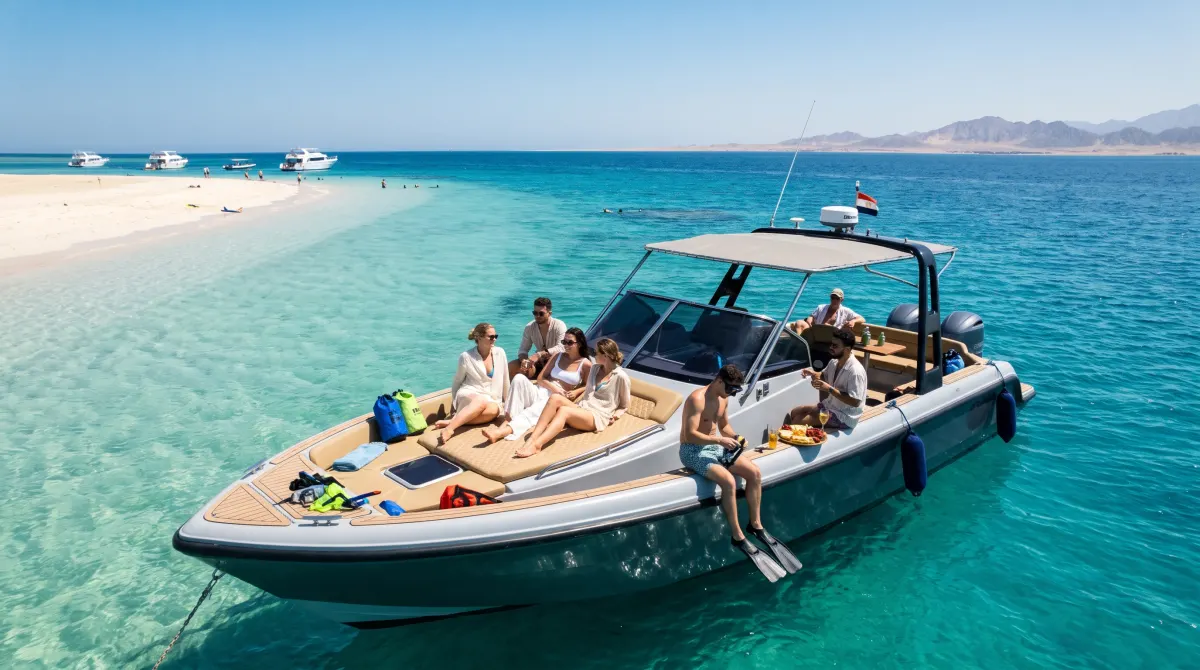
Not everyone in your group has to dive. This is a surprisingly common situation: one half of the couple is desperate to try scuba, the other would rather eat a sandwich in the shade. The solution is to choose a boat day that works for both. Snorkellers can float over the same reefs while the divers go deeper, and everyone meets back on deck for lunch.
If you'd rather build your own perfect day, with a bit of snorkelling, a quiet swim, time on a beach and no timetable dictated by 40 strangers, a private speedboat is hard to beat. You choose the island, you choose the pace, and if you decide halfway through that you want another hour at the reef, that's a chat with your skipper, not a petition.
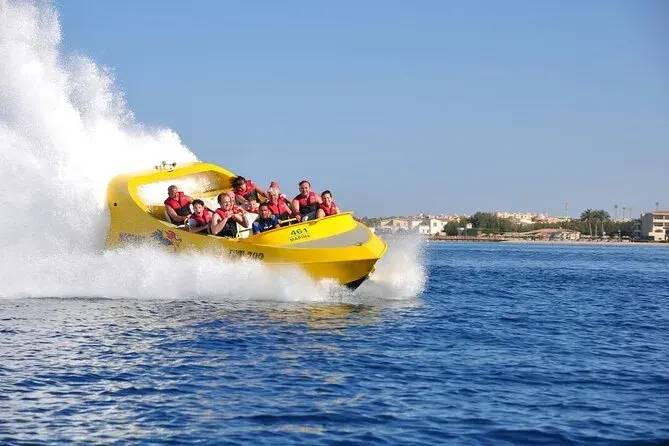
Private speedboat tour from Hurghada with snorkeling, an island visit & hotel transfers. Personalized, flexible & free consultation included.
From
Prefer a classic island day with white sand and shallow turquoise water? Our Orange Bay island tour is a very easy win for families and couples, and a lovely way to spend the day after your first dive, when you want the sea but not the scuba tank.

Orange Bay tour from Hurghada with snorkeling, a pristine beach & a boat cruise. Experience the Caribbean of Egypt with free consultation.
From
How to choose the right operator
A great intro dive comes down to the people running it. Look for a PADI (or equivalent) certified instructor, small groups, transparent pricing, clear information about what's included and a team that answers your questions without hurrying you. Be wary of anyone pushing you to book on the spot from a beach tout or hotel lobby, and run from any "dive trip" that conveniently ends with a stop at a perfume or papyrus shop.
That last point is where we're a bit stubborn. With Orient Discovery there are no shopping stops, ever. You get a clear price, an exact hotel pickup time, comfortable private transport and a team that cares more about your day than your wallet. If you're also planning to see the temples, our hour-by-hour guide to a Luxor day trip from Hurghada shows how to balance a culture day with a sea day, and our guide for cruise guests, Safaga port shore excursions, covers the same ground if you're arriving by ship.
A few tips to make your first dive better
Breathe slowly and deeply, as if you were calmly sighing. Most beginners breathe too fast, which uses up air and makes everything feel harder. Look around rather than at your gauge. Keep your hands gently by your sides instead of waving them around, and kick slowly from the hips. Don't touch the coral or the marine life, however tempting. Corals are fragile living animals, and a single careless touch can damage years of growth. Finally, point at things you love. Your instructor will happily stop for a closer look.
And if you surface with a huge grin and immediately announce that you want to do the full Open Water course, welcome to the club. It happens to a lot of us. That's the main hazard of the whole thing.
Ready to take your first breaths underwater? Have a look at our Snorkelling & Diving excursions and send us a message, and we'll sort out the details, from the exact pickup time to what to pack.