Is a 2-Day Luxor Trip Worth It? Overnight Stay, Highlights & Hot Air Balloon
A 2-day Luxor trip from Hurghada costs more time and money than a standard day trip.
In return, you do not simply get “one more temple”.
You get a different Luxor experience.
On the first day, you can visit Karnak, check into your hotel and later walk through Luxor Temple after dark.
Instead of finishing your last sightseeing stop and then spending several hours driving back to Hurghada, you stay overnight beside the Nile.
The alarm still rings very early the next morning.
This time, there is a very good reason:
a hot air balloon over Luxor at sunrise.
After that come the Valley of the Kings, Hatshepsut Temple, the Colossi of Memnon and the Nile.
That is the biggest difference between one day and two.
A day trip answers:
Can I see the main sights of Luxor from Hurghada in one day?
Yes.
A two-day trip answers a different question:
Can I experience Luxor without squeezing almost every hour between driving, temples and the journey home?
Much better.
The current private two-day tour from Orient Discovery divides Karnak and an evening in Luxor across the first day. Day two includes a sunrise hot-air balloon flight, the Valley of the Kings, Hatshepsut Temple, the Colossi of Memnon, a Nile crossing and lunch before returning to the Red Sea. One night in a 4-star hotel with breakfast is included.
In this guide, we will look at:
what two days give you compared with a day trip,
how staying overnight changes the experience,
whether a hot air balloon in Luxor is worth it,
what happens if the weather stops the flight,
what you can do in Luxor after dark,
whether the Karnak Sound & Light Show fits into the trip,
which sights can be included,
how tiring two days really are,
and who is most likely to find the extra cost worthwhile.
Luxor in 1 Day or 2 Days: Quick Comparison
If you are deciding between the two options, this table gives you the main differences.
Experience | 1 Day from Hurghada | 2 Days with Overnight Stay |
|---|---|---|
Karnak Temple | Yes | Yes |
Valley of the Kings | Yes | Yes |
Hatshepsut Temple | Yes | Yes |
Colossi of Memnon | Yes | Yes |
Nile crossing | depends on tour | possible or included depending on tour |
Luxor Temple after sunset | usually difficult to fit in | very practical |
Evening in Luxor | little or none | Yes |
Overnight by the Nile | No | Yes |
Sunrise hot-air balloon | not practical on a normal day trip | Yes |
Evening bazaar | usually no | possible |
Sightseeing spread across two days | No | Yes |
Same-day return after sightseeing | Yes | only on day two |
Cost | lower | higher |
The biggest difference is not actually in the list of monuments.
It is in how your time is used.
Why One Day in Luxor Can Still Work
A good day trip from Hurghada can show you a surprising amount.
You can visit places such as:
Karnak,
the Valley of the Kings,
Hatshepsut Temple,
the Colossi of Memnon,
and the Nile.
For travellers with limited holiday time, that can be a very good solution.
You leave early.
You see some of the most important places in ancient Egyptian history.
You return to your Red Sea hotel that evening.
Done.
The problem is not that a day trip is “bad”.
The problem comes when you really want more from Luxor but still try to force everything into that one day.
Luxor is roughly 290 kilometres from Hurghada, and the journey usually takes around three to four hours each way depending on your hotel, traffic and road conditions.
That means:
Before you enter your first temple, you have already completed a long journey.
And after the final monument, the same road still waits for you again.
The Biggest Advantage of Two Days Is Not “More Sightseeing”
That may sound strange.
You are paying more and staying longer.
Of course you want to experience more.
But the real advantage is that your itinerary is no longer compressed into one giant day.
On a one-day Luxor trip, many things compete for the same hours:
Karnak,
lunch,
the Nile,
West Bank,
tombs,
Hatshepsut,
photography,
toilet breaks,
and the drive back.
With two days, you can divide the experience.
Today we focus on Luxor, Karnak and the evening.
Tomorrow we focus on sunrise and the West Bank.
The city suddenly feels different.
Day 1: Hurghada to Luxor
A two-day trip still begins early.
You gain an overnight stay.
You do not gain teleportation.
The road from Hurghada towards the Nile Valley still takes several hours.
On a private trip, your driver collects you from your hotel and your own group travels towards Luxor.
One benefit over a larger shared coach can be avoiding a long sequence of hotel collections.
Then the landscape changes.
The Red Sea disappears.
The mountains of the Eastern Desert pass by.
Later, dry desert suddenly turns into the green Nile Valley.
For many travellers, that contrast is already part of the experience.
Karnak on the First Day
After arriving in Luxor, one of the biggest highlights usually comes first:
Karnak Temple.
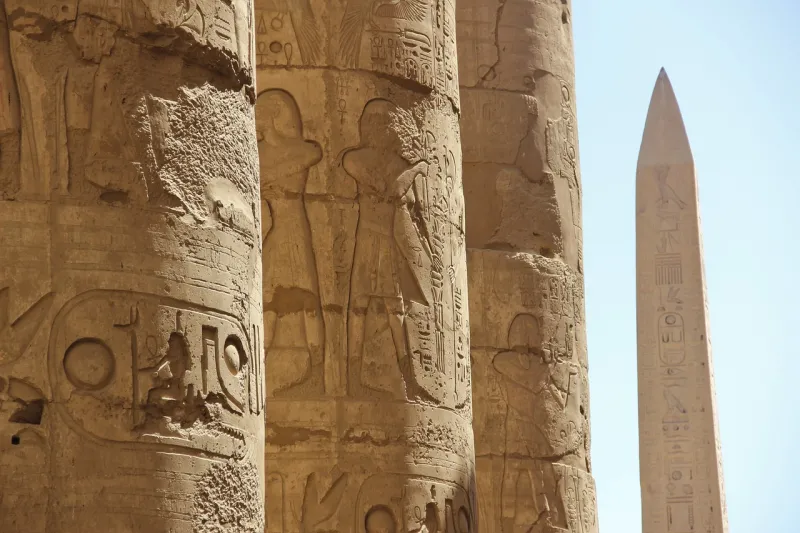
Karnak is not one single building.
It is an enormous temple complex that was expanded over many centuries.
Its famous Great Hypostyle Hall is filled with huge columns.
You can also see:
obelisks,
vast courtyards,
hieroglyphs,
sacred areas,
and the marks left by different pharaohs.
On a one-day tour, Karnak is often one of several major stops.
On a two-day itinerary, you do not immediately need to think:
Now the West Bank, now the tombs, now Hatshepsut, then four hours home.
That alone can reduce some of the pressure.
Why Hotel Check-In Changes More Than You Expect
At some point on the first day, something completely ordinary happens:
You check into your hotel.
No pharaohs.
No golden masks.
No 3,000-year-old temple.
Yet this moment matters.
Because from now on, the day no longer ends with:
“What time do we have to drive back to Hurghada?”
You can:
shower,
sit down for a while,
change clothes,
charge your phone,
have a drink,
and then go back out again.
The current two-day tour includes one night in a 4-star hotel beside the Nile with breakfast.
After a long cultural day, even a short break can feel surprisingly valuable.
Luxor Temple After Sunset: One of the Best Reasons to Stay Overnight
Luxor Temple is worth visiting during the day.
After sunset, the atmosphere changes.
Columns and statues are illuminated.
The sky becomes dark.
Warm light picks out reliefs and architecture.
Suddenly, the temple feels less like another stop on a sightseeing list and more like an evening in Luxor.
This evening visit is part of the current two-day Orient Discovery programme.
It is also something that is difficult to fit comfortably into a normal same-day trip from Hurghada.
You could wait until darkness falls.
But then you would still have the long road back to the coast.
With a two-day trip, you simply return to your hotel afterwards.
That is a big difference.

Luxor Bazaar in the Evening
After the temple, you can let the evening continue a little longer.
The current itinerary also includes time around Luxor’s bazaar.
That can be enjoyable because you are finally spending time somewhere that is not just a monument or vehicle.
You may see:
shops,
spices,
clothing,
souvenirs,
cafés,
everyday city life,
and Luxor after the main daytime sightseeing has finished.
You do not have to buy anything.
You can simply look around.
If you do want to buy something, bargaining may be part of the experience.
If you are not interested, a friendly:
“La, shukran.”
usually says enough.
Karnak Sound & Light Show: Can You Add It in the Evening?
Yes, it can be an interesting optional evening activity.
But there is an important distinction:
The Karnak Sound & Light Show is not currently included in the Orient Discovery two-day tour.
If the show matters to you, ask before booking whether the evening itinerary can be adjusted.
The official Sound & Light programme currently lists an English performance in the evening, with additional performances and languages depending on the day.
Times can change.
So check the current schedule close to your travel date.
An evening in Luxor is too valuable to plan around an old screenshot from a travel forum.
Luxor Temple or the Sound & Light Show?
If you only have time for one evening activity, I would not automatically choose the show.
It depends on your interests.
Luxor Temple after dark may suit you better if:
you want to walk through an illuminated ancient temple,
photography matters to you,
you prefer exploring rather than watching a performance,
and Luxor Temple is still on your sightseeing list.
The Sound & Light Show may suit you better if:
you have already visited Karnak during the day,
you enjoy narrated evening performances,
light projections appeal to you,
and you do not mind paying for an additional ticket.
You do not need to squeeze everything into one evening.
The point of two days is to reduce the rush.
Not create a new evening marathon.
Then the Alarm Goes Off
You booked two days.
You slept in a hotel.
You may think:
Now things become relaxed.
Then your alarm rings very early.
The reason is the Luxor hot-air balloon flight.
Balloon flights take place around sunrise.
That means you need to reach the launch area before the day properly begins.
So two days do not necessarily mean more sleep.
They mean that your very early start happens in Luxor.
Not 290 kilometres away in Hurghada.
Why Hot-Air Balloon Flights in Luxor Are So Popular
From ground level, you experience Luxor as a series of separate places.
Karnak.
The Nile.
The West Bank.
Fields.
Desert.
Mountains.
Tombs.
Temples.
From a balloon, you suddenly see how these landscapes fit together.
Below you may see the green agricultural land surrounding the Nile.
Almost immediately beside it begins the dry desert.
To the west rise the cliffs of the Theban necropolis.
Depending on wind and flight direction, you can get different views of temples, villages, fields and the West Bank.
That is why claims such as:
“You will definitely fly directly over the Valley of the Kings.”
should be treated carefully.
A hot-air balloon does not follow a railway line.
Wind controls the route.
The views can be spectacular.
They are not exactly the same every morning.
How Does a Luxor Hot-Air Balloon Ride Work?
The exact process depends on the balloon operator.
A typical morning looks something like this:
very early hotel collection,
transfer towards the West Bank or launch area,
balloon preparation,
safety briefing,
boarding the basket,
take-off around early morning,
flight according to wind conditions,
landing,
return transfer.
Even the preparation can be memorable.
A huge balloon begins flat on the ground.
Then it starts filling.
Burners light up in the darkness.
Other balloons slowly rise into shape nearby.
Eventually this enormous envelope is standing above you.
By that point, you are normally fully awake.
Coffee becomes optional.
How Long Does the Balloon Flight Last?
Actual flight time varies.
It can depend on:
weather,
wind,
aviation clearance,
landing opportunities,
and the operator.
That is why it is better not to promise an exact number of minutes.
The morning also includes more than the time in the air.
Hotel collection, preparation, the safety briefing and return transfer all form part of the experience.
If you have another fixed appointment afterwards, your itinerary should include enough buffer.
Is a Hot-Air Balloon in Luxor Safe?
It is a fair question.
A balloon flight is still an aviation activity.
It should not be dramatised, but it should not be presented as something with zero risk either.
The key point is:
Flights operate only when conditions allow them to operate.
Wind and weather matter.
That means balloon trips can also be cancelled at short notice.
That is frustrating.
But a cancellation because conditions are unsuitable is much better than an operator insisting on flying simply to keep the timetable intact.
Listen carefully to the safety briefing.
Follow the crew’s instructions during take-off and landing.
If you have health concerns, are pregnant, have difficulty getting in and out of the basket, or cannot stand comfortably for the flight, discuss suitability before booking.
What Happens If the Balloon Is Cancelled Because of Weather?
This is one of the most useful questions to ask before booking.
For the current Orient Discovery two-day tour, the published policy states that if the balloon flight is cancelled because of weather, €90 per person is refunded.
Policies can change.
Check the current terms when you book.
A cancelled balloon flight does not automatically cancel the rest of the Luxor trip.
You still have:
the Valley of the Kings,
Hatshepsut Temple,
the Colossi of Memnon,
the Nile,
and the rest of your sightseeing.
A cancelled flight is disappointing.
It does not make the whole two-day trip pointless.
Is the Luxor Hot-Air Balloon Really Worth It?
If you are comfortable with flying and do not dislike the thought of standing in an open basket:
For many travellers, yes.
Not only for the photograph.
The perspective is the real reason.
During the day, you stand in front of a temple and see its columns.
The next morning, you see how temples, fields, desert and mountains all relate to one another.
It changes your sense of Luxor.
Still, a balloon ride is not compulsory.
If you have:
strong fear of heights,
discomfort with balloon travel,
no interest in waking very early,
or physical limitations,
you can still have a brilliant Luxor trip without it.
A good holiday does not need to become a bravery test.
After the Balloon: Breakfast
And now something suddenly sounds extremely attractive:
Breakfast.
After the early balloon experience, you return to the hotel.
Breakfast is included on the current tour.
This is a good moment for:
coffee,
water,
something warm to eat,
and perhaps ten minutes when nobody says the words “Ramesses II”.
Then the second part of the day begins.
The West Bank.
Valley of the Kings on Day Two
This is where the overnight stay becomes especially useful.
You have not just spent three or four hours driving from Hurghada.
You are already in Luxor.
The Valley of the Kings can therefore sit naturally in the morning schedule.
This is where pharaohs of the New Kingdom were buried inside rock-cut tombs.
You do not simply enter one “Valley of the Kings tomb”.
Several tombs may be open.
The standard admission normally covers a set number of regular tombs.
On the current two-day tour, entry to three standard tombs is included.
Is Tutankhamun’s Tomb Included?
Not in the standard tour inclusions.
The current itinerary lists extra tombs such as Tutankhamun and Seti I separately.
If you want to visit one of them, you need the relevant official extra ticket.
Tell your guide beforehand.
Then the visit can be planned properly.
It is frustrating to reach the entrance and suddenly realise:
“That was the one tomb we really wanted to see.”
when the schedule no longer allows for it.
Which Tomb Is the Best?
That question is almost as difficult as:
Which Egyptian god is the most interesting?
It depends on what you want.
Different tombs may impress you with:
colour,
long corridors,
astronomical scenes,
large burial chambers,
or historical importance.
Tomb openings can change.
That is why an up-to-date Egyptologist is more useful than a fixed ranking from an old blog.
Simply tell your guide what interests you.
For example:
“I want to see especially colourful tombs.”
Or:
“I am particularly interested in Ramesses.”
Then your guide can advise you based on what is open.
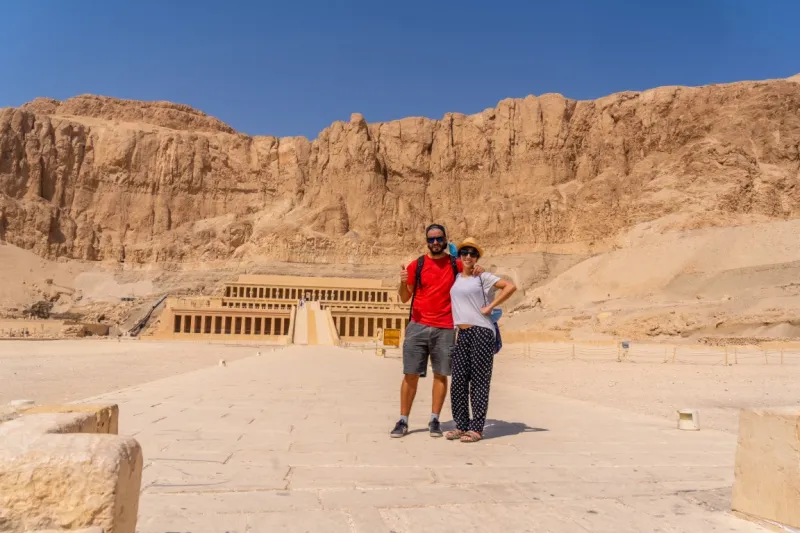
Hatshepsut Temple
After the tombs comes the Temple of Queen Hatshepsut at Deir el-Bahari.
Its location is already striking.
The temple sits directly against the high cliffs of the West Bank.
Its terraces and ramps look completely different from Karnak.
Try not to treat it only as the famous photograph from the front.
Hatshepsut’s story is just as interesting as the architecture.
She was a woman who ruled as pharaoh.
Her political position, how she was represented and what happened to some of her images after her reign make her one of the most interesting rulers of the New Kingdom.
With your own Egyptologist, you can go further than simply walking up the terraces and back down again.
Colossi of Memnon
The Colossi of Memnon are usually a shorter stop.
Two enormous seated statues stand in front of what was once the mortuary temple of Amenhotep III.
Today they can look almost isolated.
In the pharaoh’s time, they belonged to a much larger complex.
Most visitors do not need an hour here.
A short historical explanation and enough time for photographs will often be enough.
And that is fine.
Not every monument needs the same amount of time.
Crossing the Nile by Motorboat
The current two-day tour includes a motorboat ride across the Nile.
After temples, tombs and desert landscapes, this is a pleasant change.
You spend a few minutes on the water.
Luxor sits on both sides.
Beyond it are fields, palms and the West Bank.
It is not a major cruise experience.
That is part of the charm.
It is simply a short, calm moment in the middle of a history-heavy trip.
Two Days Are Not Automatically “Relaxing”
The word gets used a lot around overnight tours.
It is better to be realistic.
Two days in Luxor can still be tiring.
You still have:
the long outward journey,
lots of sightseeing,
an early balloon morning,
plenty of walking,
heat,
and the return journey on day two.
The difference is not:
Day trip = exhausting. Two-day trip = spa holiday.
The difference is:
The sightseeing can be distributed better.
You do not remove the distance.
You avoid putting the outward drive, return drive and all major attractions into the same day.
How Much Does a 2-Day Luxor Trip from Hurghada Cost?
The price depends on:
group size,
hotel category,
collection point,
vehicle,
included tickets,
balloon flight,
and extra services.
The current private Orient Discovery tour is advertised from €250 per person.
Current example pricing varies depending on the number of travellers, with smaller private groups paying more per person and larger groups paying less.
Hotel upgrades and single-room supplements can also affect the total.
Prices can change.
Always check the rate for your date and group size.
Why Does a Two-Day Tour Cost Much More Than a Day Trip?
Because you are not only buying an extra hotel night.
The current programme includes items such as:
private transport,
vehicle use across two days,
personal Egyptologist,
hotel stay,
breakfast,
two lunches,
hot-air balloon flight,
entrance tickets,
three standard Valley of the Kings tombs,
Karnak,
Luxor Temple,
Hatshepsut Temple,
the Colossi of Memnon,
and a Nile boat crossing.
That explains the price difference far better than simply calling it “premium”.
The question should not be:
“Why do two days cost more?”
Of course two days cost more.
The better question is:
“Are the extra experiences and slower structure worth the extra cost for me?”
What Is Included in the Current Private Two-Day Tour?
According to the current tour description, the package includes:
return transfer in a private air-conditioned vehicle,
one night in a 4-star Nile hotel,
breakfast,
two lunches,
German- or English-speaking Egyptologist,
sunrise hot-air balloon flight,
admission to the listed main attractions,
three standard tombs in the Valley of the Kings,
Hatshepsut Temple,
the Colossi of Memnon,
Karnak,
Luxor Temple,
motorboat ride across the Nile,
and an itinerary without compulsory shopping stops.
Private 2-Day Luxor Tour with a German-speaking Egyptologist, 4★ hotel, and modern vehicles. No shopping stops. Free consultation & 24/7 support.
From
What Is Not Included?
For a higher-priced trip, this list matters just as much.
Current exclusions include:
drinks with meals,
personal expenses,
tips,
special tombs such as Tutankhamun or Seti I,
selected pick-up supplements,
and the Karnak Sound & Light Show.
These are the details you want to know before paying.
Not halfway through the second day.
Is the Overnight Stay Worth It Even Without the Balloon?
Yes.
This matters.
The Luxor hot-air balloon is one of the strongest reasons to choose the two-day trip.
It is not the only one.
Even without the balloon, you still get:
Luxor in the evening,
Luxor Temple after sunset,
a night beside the Nile,
sightseeing divided over two days,
less pressure to fit everything into one schedule,
and a second morning already in Luxor.
If the balloon is cancelled because of weather, your trip still feels very different from a standard day tour.
Is a Two-Day Tour Better for Families?
For some families, much better.
The main reason is simple:
The programme is divided.
Children do not necessarily need to:
drive three or four hours,
see several temples,
walk through tombs,
have lunch,
visit more attractions,
and then drive another three or four hours home
all on the same day.
An overnight stay can make the rhythm easier.
There is one catch:
The balloon morning starts very early.
Different balloon operators may also have their own minimum age or height rules.
If you are travelling with children, check this before booking.
What Is More Exciting for Children: Temples or the Balloon?
It depends on the child.
Some children love:
tombs,
mummy stories,
gods,
hieroglyphs.
Others are ready to file an official complaint with the pharaohs after the third temple column.
The balloon gives the trip a completely different kind of experience.
Suddenly it is not only history.
It becomes:
fire,
take-off,
height,
sunrise,
landscape,
and huge views.
A good private guide can also keep historical explanations shorter and more story-based for younger travellers.

Is the Two-Day Tour Better for Older Travellers?
It can be.
The sightseeing is spread out more comfortably.
You have a hotel break.
And after the first sightseeing day, you do not need to drive straight back to Hurghada.
That helps.
Still, two days do not mean the trip becomes physically easy.
The Valley of the Kings involves:
walking,
ramps,
steps,
heat,
and different tomb entrances.
For the balloon, you need to get in and out of the basket and stand during the flight.
If mobility is limited, ask specific questions:
How high is the basket entrance?
How long will I need to stand?
Which tombs are easier to access?
Can we add more breaks?
Can we skip a stop?
A private tour gives you more flexibility.
It does not remove physical limitations.
What Should You Pack for One Night in Luxor?
Keep it simple.
You do not need a second full suitcase.
A small overnight bag is usually enough.
Take:
passport or required documents,
fresh clothes,
toothbrush,
personal medication,
sun cream,
sunglasses,
hat,
comfortable shoes,
power bank,
charging cable,
camera or phone,
some cash,
light jacket in winter,
and perhaps a small snack.
The balloon morning can feel much cooler than the afternoon, particularly in winter.
A light extra layer can be useful.
Best Time for a 2-Day Luxor Trip
The cooler months are usually more comfortable for longer cultural trips.
From autumn through spring, many travellers find the temperatures easier for extended sightseeing.
You can still visit Luxor in summer.
Planning simply matters more.
Remember to:
drink water,
wear a hat,
use sun protection,
take breaks,
choose light clothing,
and respect the midday heat.
The balloon has one nice advantage during warmer months:
You are already out very early.
The strongest heat comes later.
Is a Two-Day Luxor Trip Romantic?
That depends on your definition of romantic.
If you mean:
Candlelight and eight hours beside the pool?
Probably not.
If you mean:
sunset beside the Nile,
illuminated Luxor Temple,
an evening walk,
staying by the river,
and sunrise in a hot-air balloon,
Luxor makes a fairly good case.
Couples often choose two days not because they want to collect more monuments, but because the trip feels more like a short city break and less like one very long excursion.
Photography: Why Two Days Are Much Better
For photography, two days give you several types of light.
Day 1
desert journey,
Karnak in daylight,
Nile in the afternoon,
Luxor Temple at night.
Day 2
balloons before sunrise,
golden morning light,
West Bank,
Valley of the Kings,
Hatshepsut Temple,
Nile.
That is very different from a one-day trip where almost all photography happens between late morning and afternoon.
Luxor Temple at night and sunrise over the West Bank give you photographs that are difficult to get on a normal day trip.
One Day or Two Days: Which Suits You?
Choose a day trip if:
you only have one free day,
your budget is limited,
you mainly want to see the headline attractions,
long days do not bother you,
and the balloon is not important to you.
Choose two days if:
Luxor is one of the main parts of your Egypt holiday,
you want to see Luxor Temple after sunset,
you want a hot-air balloon ride in Luxor,
you like the idea of staying beside the Nile,
you prefer spreading the monuments across two days,
you enjoy photography,
or you want an evening in Luxor.
What About Three Days?
If two days still leave you thinking:
I want even more history, another route starts to make sense.
With three days, you can combine Luxor with less-visited temples.
Two particularly strong options are:
Dendera,
and Abydos.
The Temple of Hathor at Dendera is known for surviving colour, astronomical ceilings and Hathor columns.
Abydos has some of the finest New Kingdom reliefs and the famous King List of Seti I.
If that sounds like your kind of trip, read our guide to Dendera Temple from Hurghada and Abydos.
A multi-day route makes far more sense than trying to squeeze Dendera into an already full Luxor day.
11 Reasons a 2-Day Luxor Trip Can Be Worth It
1. You Do Not Have to Fit Everything into One Day
East Bank and West Bank sightseeing can be divided more naturally.
2. You See Luxor Temple After Sunset
The lighting changes the entire atmosphere.
3. You Sleep in Luxor
After day one, there is no long return journey to Hurghada.
4. You Can Take a Sunrise Hot-Air Balloon Flight
That is very difficult to combine sensibly with a normal same-day trip from Hurghada.
5. You Experience Luxor as a City
Not only as a collection of archaeological stops.
6. You Can Walk Through the Bazaar in the Evening
Without immediately getting back into a vehicle.
7. The West Bank Gets Its Own Day
The Valley of the Kings and Hatshepsut do not need to be squeezed in after Karnak.
8. Photography Gets Better
You get daylight, night lighting and sunrise.
9. Breaks Feel More Natural
Particularly useful for families and older travellers.
10. Your Own Egyptologist Can Focus More on Your Interests
More history or shorter explanations, depending on what you prefer.
11. Luxor Feels Like a Destination
Not just a very long excursion from a beach resort.
FAQ: 2-Day Luxor Trip from Hurghada
Are Two Days Enough for Luxor?
Two days are very good for the main highlights.
You still will not see everything. Luxor has many more temples, museums, tombs and archaeological sites.
Is One Day Enough for Luxor?
Yes, if you focus on the main highlights.
Karnak, the Valley of the Kings, Hatshepsut Temple and the Colossi of Memnon can be combined in a well-organised day trip.
How Far Is Luxor from Hurghada?
Luxor is roughly 290 kilometres from Hurghada, with around three to four hours of driving each way depending on conditions.
What Time Does the Luxor Hot-Air Balloon Start?
Balloon flights take place very early around sunrise.
The exact pick-up and launch time depends on the season, operator and current conditions.
Does the Balloon Fly Directly over the Valley of the Kings?
Not necessarily.
Hot-air balloons travel according to wind direction, so the exact route and views vary.
Can the Balloon Flight Be Cancelled?
Yes.
Wind and weather conditions can lead to cancellation.
Do I Get Money Back If the Balloon Is Cancelled?
Under the current Orient Discovery policy, a weather-related cancellation of the balloon ride results in a €90-per-person refund. Check the current terms before booking.
Is the Hotel Included?
The current private two-day tour includes one night in a 4-star hotel beside the Nile with breakfast.
Are Lunches Included?
The current itinerary includes two lunches. Drinks with meals are not included.
Is Tutankhamun’s Tomb Included?
No.
It requires a separate official ticket.
How Many Valley of the Kings Tombs Are Included?
The current tour includes admission to three standard tombs.
Is the Karnak Sound & Light Show Included?
No.
It is currently listed as an extra, not part of the standard tour.
Can I Still Visit the Sound & Light Show?
Possibly.
Ask before booking whether your evening programme can be adjusted. Official show times can change.
Is Luxor Temple Visited at Night?
Yes.
The current two-day itinerary includes Luxor Temple after sunset.
Is a Two-Day Tour Tiring?
It can be.
You distribute the sightseeing better, but you still have long drives, early starts, plenty of walking and a full programme.
Is the Tour Suitable for Children?
For many families, splitting the sightseeing across two days can work well.
Balloon operators may apply their own age or height restrictions.
Are There Shopping Stops?
The current private two-day tour is offered without compulsory shopping stops.
So, Is a 2-Day Luxor Trip Really Worth It?
If your only goal is:
I want to see Karnak and the Valley of the Kings once, you do not necessarily need two days.
A good day tour can do that.
But if you say:
Luxor should be one of the main parts of my Egypt trip, an overnight stay changes the experience considerably.
You do not simply drive there and back.
You stay.
You see Luxor Temple after dark.
You walk through the city when many day visitors are already leaving.
You sleep beside the Nile.
The next morning, you wake before sunrise and see Luxor from the air.
Then you head into the Valley of the Kings.
Private 2-Day Luxor Tour with a German-speaking Egyptologist, 4★ hotel, and modern vehicles. No shopping stops. Free consultation & 24/7 support.
From
A 2-day Luxor trip from Hurghada is therefore not automatically “better” than a day trip.
It is better for a particular type of traveller.
For people who do not simply want to tick names off a list.
For people who want to still be in Luxor after sunset.
For people who would rather watch sunrise from a balloon than from the road between Hurghada and Qena.
And for people who do not want to leave the Valley of the Kings thinking:
That was amazing. Now we have another four-hour drive.
The extra cost does not simply buy you a second day.
It buys you the edges of the day.
The evening.
The night.
The sunrise.
And some of Luxor’s best moments happen exactly there.