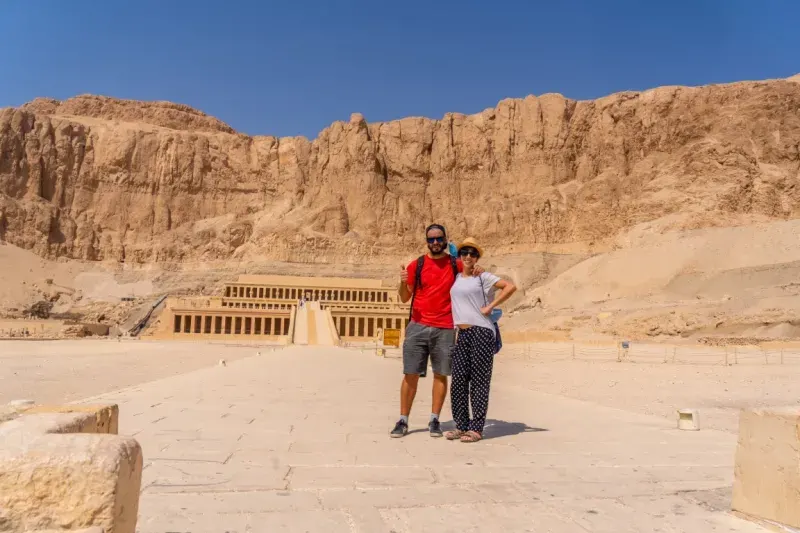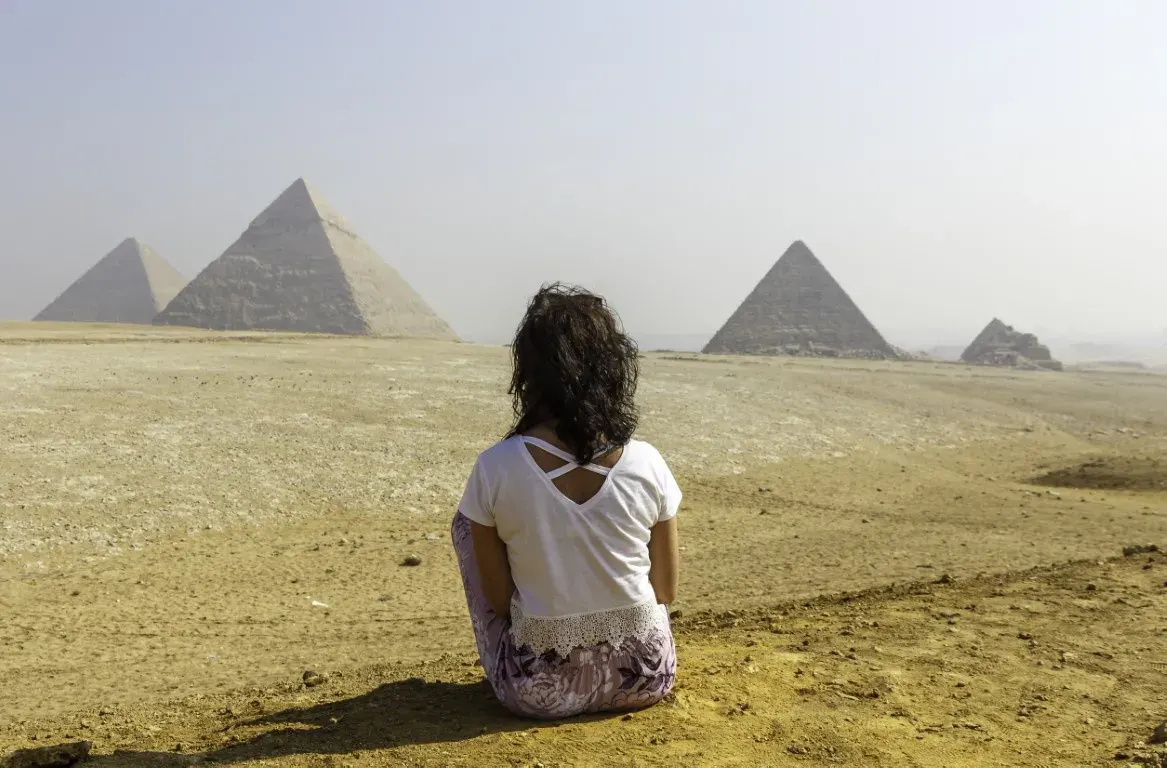
The Pyramids of Giza are among those rare sights that almost everyone has seen in a photograph before visiting.
A photograph still does a poor job of preparing you for their actual size.
You stand on the edge of Giza, look up and see rows of stone rising towards the sky. A single limestone block can already look bigger than your hotel bed. Then you learn that the Great Pyramid alone is estimated to contain around 2.3 million stone blocks.
At that point, the sentence “the ancient Egyptians built a pyramid” starts to sound rather different.
The three main pyramids were built during Egypt’s Fourth Dynasty. The largest was constructed for Pharaoh Khufu, known in Greek as Cheops. It was followed by the pyramid of his son Khafre, or Chephren, and that of Menkaure, or Mykerinos.
Together with the Great Sphinx, temples, smaller pyramids, tombs and other structures, they form one of Egypt’s most important archaeological landscapes.
The Fourth Dynasty is generally dated to roughly 2613 to 2494 BC.
The Great Pyramid is particularly unusual.
It is the only surviving monument from the traditional Seven Wonders of the Ancient World. It originally stood at around 146.5 metres and remained the tallest human-made structure on Earth for roughly 3,800 years.
More than 4,500 years after it was built, it is still standing.
That alone would be impressive.
The wider site makes the story even better.
Giza Is Much More Than Three Pyramids
Many first-time visitors imagine three large pyramids, a Sphinx and a lot of desert.
That is only part of the site.
The Giza Pyramid Complex was a huge royal cemetery.
Each main pyramid belonged to a much larger funerary complex.
These could include:
the king’s pyramid,
smaller queens’ pyramids,
a mortuary temple,
a valley temple,
a long causeway linking the temples,
boat pits,
mastabas and other tombs,
and cemeteries for members of the royal court and senior officials.
The pyramid was therefore not simply a giant pile of stone with a burial chamber somewhere inside.
It stood at the centre of a religious system.
After the king’s death, rituals continued. Offerings were made, priests worked in the temples and the dead ruler was expected to take his place in the divine world.
Looking at Giza as nothing more than three geometric buildings is a bit like explaining an airport by showing only the runway.
The big shapes catch your attention first.
The rest of the story lies around them.
The Three Main Pyramids at a Glance
The oldest and largest pyramid belongs to Khufu.
His reign is generally placed around 2589 to 2566 BC. The Great Pyramid was built as his royal burial monument and is the oldest of Giza’s three main pyramids.
Next stands the pyramid of Khafre.
It is slightly smaller than the Great Pyramid, yet from some viewpoints it looks just as large or even larger. One reason is that it stands on a higher part of the plateau.
Part of its original outer limestone casing still survives near the top.
That matters because the pyramids originally looked very different from the rough monuments we see today.
The exposed stone courses were not intended to be the finished outer surface. Much of each pyramid was covered with carefully dressed limestone.
The smallest of the three main pyramids belongs to Menkaure.
It is considerably lower, but it formed part of the same royal cemetery and had its own funerary complex.
Smaller pyramids, tombs and temples surround the main monuments.
The difference in scale makes visiting them more interesting.
After five minutes beside the Great Pyramid, even a fairly large modern building may begin to suffer from an identity crisis.
Where Does the Great Sphinx Fit In?
East of Khafre’s pyramid lies the Great Sphinx of Giza.
It was carved directly from the natural rock of the plateau and is generally dated to the Fourth Dynasty.
Its lion’s body and human head combine royal identity with the strength of a lion.
The exact identity represented by the Sphinx has been debated for a long time, although the strongest archaeological interpretation links it with Khafre and his pyramid complex.
Later in this guide, we will look at questions such as:
Whose face does the Sphinx show?
What happened to its nose?
What does the Dream Stele between its paws say?
How deeply was the Sphinx once buried in sand?
Which stories about Napoleon belong firmly in the myth section?
The Sphinx is almost as good at attracting legends as it is at attracting cameras.
The Last Surviving Wonder of the Ancient World
The Great Pyramid holds a title that no other surviving monument can claim.
Of the traditional Seven Wonders of the Ancient World, it is the only one still standing.
The other wonders are known mainly through ancient descriptions, archaeological remains and later representations.
At Giza, you can stand directly in front of the original structure.
With the correct extra ticket, you may even enter part of the Great Pyramid.
Do not expect golden walls, colourful hieroglyphs or richly painted burial chambers.
Anyone arriving after seeing the Valley of the Kings will need to adjust their expectations.
Inside the Great Pyramid, the experience comes from something else:
narrow passages,
immense masses of stone,
the Grand Gallery,
the King’s Chamber,
granite construction,
and the question of how people more than four thousand years ago planned and built all of it.
Giza tells its story mainly through architecture rather than colour.
Why Are the Pyramids of Giza a UNESCO World Heritage Site?
Giza forms part of the UNESCO World Heritage Site Memphis and its Necropolis – the Pyramid Fields from Giza to Dahshur.
The area joined the World Heritage List in 1979.
The protected landscape includes far more than the three famous pyramids. It stretches across major ancient burial grounds including Giza, Saqqara, Abusir and Dahshur.
This matters because the history of pyramid building does not begin with Khufu.
Before Giza, Egyptian architects had already spent generations experimenting with burial forms, stone construction and pyramid angles.
Without:
early mastabas,
Djoser’s Step Pyramid,
the Bent Pyramid,
and Sneferu’s Red Pyramid,
the Great Pyramid would probably not look the way it does today.
Giza was not the first attempt.
It was the result of a long period of learning.
Why Were the Pyramids Built West of the Nile?
The western location carried religious meaning.
Ancient Egyptians connected the daily movement of the sun with death and rebirth.
The sun rises in the east.
That is where the day begins.
In the evening, it disappears in the west.
According to ancient Egyptian belief, the sun then began its night journey through the underworld before returning in the east the following morning.
The west therefore became strongly associated with:
death,
burial,
the afterlife,
and the hope of rebirth.
Many major cemeteries were built west of the Nile.
You see the same principle much later at Luxor, where the Valley of the Kings and much of the Theban Necropolis lie on the West Bank.
For ancient Egyptians, sunset was not simply a nice moment for a photograph.
It was a daily model of death and return.
Why Was Giza Chosen?
Religion explains only part of the location.
A pyramid weighing millions of tonnes also needs a suitable building site.
The Giza Plateau offered several advantages.
Solid Ground
A monument of this size needs a stable base.
The plateau is formed largely from limestone, which provided solid ground for the pyramids.
The builders still had to prepare the foundation with great care.
On a structure roughly 230 metres wide, even a small error in levelling could become a much bigger problem higher up.
Stone Close to the Building Site
Much of the limestone could be quarried directly on or near the plateau.
That reduced the need for long overland transport.
Higher-quality limestone used for outer casing came from other quarries, while granite for important parts of the Great Pyramid travelled from Upper Egypt.
We will look at those transport routes later.
“Moving stone from the Nile to the building site” sounds fairly simple until one of the granite blocks weighs several dozen tonnes.
Close to Memphis
Giza also stood near Memphis, one of the main political and economic centres of the Old Kingdom.
A royal building project needed:
workers,
food,
timber,
copper tools,
stone,
ropes,
boats,
administrators,
craftsmen,
and a huge amount of organisation.
The pyramids were not built by a group of unusually enthusiastic men who woke up one morning and said:
“Today we stack some stones.”
A powerful state stood behind the project.
Access to the Nile
The Nile was Egypt’s main transport route.
Research into the ancient landscape supports the idea that now-vanished branches of the river and harbour areas played an important role in supplying the pyramid fields.
Heavy material could therefore be brought much closer to the construction area by boat than the modern landscape suggests.
Looking at Giza today, you see city roads, buildings and dry ground.
Four and a half thousand years ago, the setting was different.
That point matters throughout this guide:
We should not explain an ancient building site using only the modern Google Maps view.
Were the Pyramids Really Just Tombs?
The pyramids were royal burial monuments.
Calling them “just tombs” is still too narrow.
Each belonged to a complete funerary complex and played a part in the royal cult after death.
Ancient Egyptians did not believe the king simply ceased to exist.
He was expected to continue, join the gods and remain part of the cosmic order.
That required:
preservation of the body,
burial rituals,
offerings,
religious beliefs and practices,
cult buildings,
and a permanent royal monument.
The pyramid was therefore a tomb, royal monument and religious centre at the same time.
That leads to another question:
How did Egyptian architects develop the idea of a pyramid in the first place?
The answer does not begin at Giza.
It begins with something much lower that looks rather like a giant stone bench.
From the Mastaba to Giza: How Pyramid Building Developed
The Pyramids of Giza did not appear from nowhere.
Before Khufu built the Great Pyramid, Egyptian architects had already spent generations experimenting with burial design, stone, angles and construction methods.
Giza can be seen as the result of a long learning process.
And that process was not always smooth.
Some buildings were enlarged.
Others changed form during construction.
One pyramid even had its angle reduced partway through the work.
That is why Saqqara, Meidum and Dahshur are so useful for understanding Giza.
They do not only show finished monuments.
They show how the idea of the pyramid developed step by step.
The Mastaba: The Pyramid’s Earlier Form
Before Egyptian kings built pyramids, rulers and high-ranking officials were often buried in structures called mastabas.
The word “mastaba” comes from Arabic and roughly means “bench”.
The shape explains the name.
A mastaba has a low rectangular superstructure with a flat roof.
The burial chamber itself lies underground.
A shaft leads down to the burial, while rooms above could be used for offerings and the funerary cult.
This form existed before the large pyramids.
The mastaba did not suddenly disappear as a failed old idea.
It provided the basis for one of the largest architectural changes in history.
At some point, somebody asked an important question:
What happens when you do not build only one mastaba?
What happens when you stack several of them on top of each other?
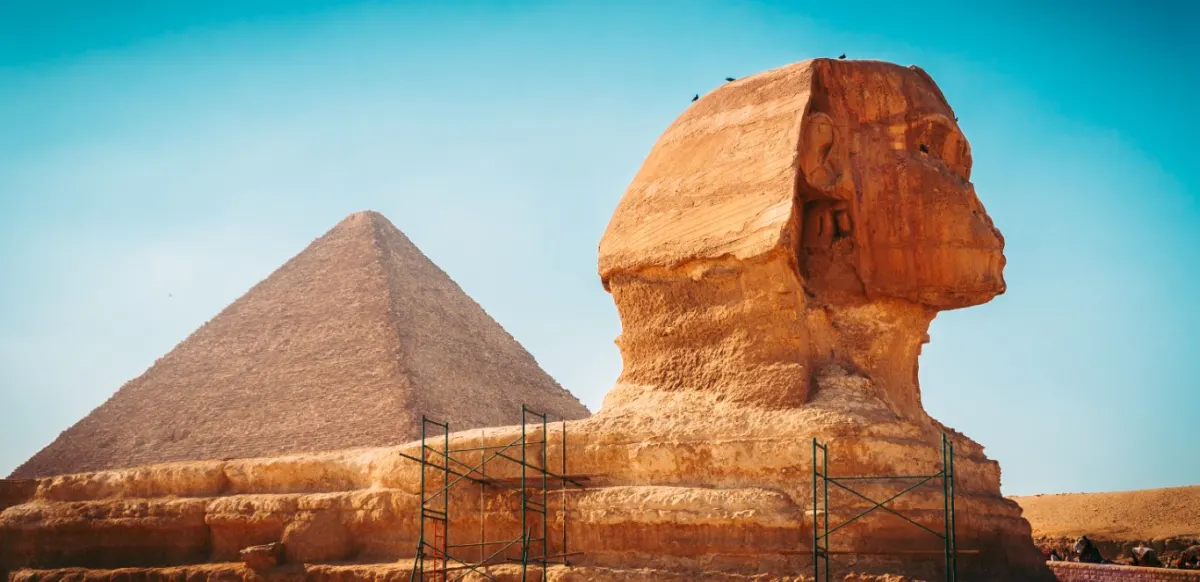
Djoser and Egypt’s First Pyramid
The answer still stands at Saqqara.
During the Third Dynasty, King Djoser built his enormous funerary complex there.
His architect is traditionally identified as Imhotep.
The idea changed royal tomb building.
Instead of constructing one rectangular mastaba, the builders created a structure made from several mastaba-like levels placed one above another.
The result was six clear steps narrowing towards the top.
The Step Pyramid of Djoser was born.
It did not yet have the smooth sides we associate with the later pyramids at Giza.
That is exactly why it matters.
You can almost see the transition.
At the base, the old mastaba idea is still visible.
Above it, something completely new rises.
Why Was Djoser’s Pyramid So Important?
The change was not only about shape.
Djoser’s complex showed what monumental stone architecture could achieve.
Courtyards, walls, religious buildings and symbolic spaces surrounded the pyramid.
Some stone buildings even copied architectural forms that had previously been made from materials that did not last as long.
Stone created a world intended to remain for the king.
The scale also changed.
A royal tomb was no longer simply a structure over an underground chamber.
It could dominate the entire landscape.
The pyramid became visible.
Monumental.
And rather difficult to miss.
That displayed royal power very effectively.
It also gave builders a new problem:
How do you turn a stepped pyramid into a true pyramid with smooth sides?
Djoser did not provide the final answer.
Egypt needed more experimentation.
Meidum: An Important Step Between Saqqara and Dahshur
The pyramid at Meidum plays an important role in the transition from stepped to smooth-sided pyramid.
Today, it looks unusual.
A high stepped core rises above a large field of stone and debris.
The original structure was much larger.
The monument appears to have begun as a stepped pyramid and later been altered towards a smooth-sided design.
Meidum also contains building solutions that point towards later developments.
Early forms of corbelled construction and systems for carrying the weight over internal spaces appear there.
Similar principles would later be used on a much larger scale at Giza.
Meidum is therefore more than a strange-looking ruin.
It is part of the technical history behind the Great Pyramid.
Sneferu: The King Who Turned Pyramid Building into a Major Programme
The next major step came under Sneferu, first king of the Fourth Dynasty.
Sneferu was Khufu’s father.
Khufu’s later achievement was possible partly because a huge amount of experimentation had already taken place during Sneferu’s reign.
Sneferu is linked with several major pyramid projects, including Meidum, the Bent Pyramid and the Red Pyramid at Dahshur.
Khufu did not receive a blank sheet of paper.
He inherited decades of research and development in stone.
The Bent Pyramid: A Monument That Changed Its Angle
The Bent Pyramid at Dahshur is one of the clearest places to see that Egyptian architects learned during real building projects.
The lower part rises at a steep angle.
Higher up, the angle suddenly becomes shallower.
That creates its famous bent profile.
The lower part appears to have begun with an angle of around 55 degrees. Structural concerns led the builders to continue the upper part at roughly 43 degrees.
The result looks unusual today.
At the time, changing the angle was probably a practical response to a building problem.
The builders saw that the original plan was causing difficulties.
So they changed it.
That sounds surprisingly modern.
A huge project is not going according to plan.
The team identifies a problem.
The plan changes.
Only in their case, the project file weighed several million tonnes.
Was the Bent Pyramid a Failure?
Calling it simply a failed experiment would be misleading.
The pyramid is still standing more than 4,500 years later.
That is a fairly good lifespan for a “mistake”.
More importantly, its builders could learn from it.
The Bent Pyramid shows the transition between earlier stepped forms and later smooth-sided pyramids.
It also shows that Egyptian architecture was not based on one unchanging formula.
Builders:
observed problems,
adjusted construction,
changed angles,
improved methods,
and applied lessons to later projects.
That makes the Bent Pyramid especially useful for understanding Giza.
It shows the learning process.
The Red Pyramid: The Classic Shape Works
Not far from the Bent Pyramid, Sneferu built another major monument.
Today, we call it the Red Pyramid.
Its name comes from the reddish colour of the exposed limestone core. Originally, it too had a bright Tura limestone casing.
Here, builders achieved the continuous smooth-sided form we now immediately recognise as a classic Egyptian pyramid.
No visible steps.
No sudden change of angle.
A clear geometric shape from base to summit.
By this point, a major technical problem had been solved.
The question was no longer:
Can a large smooth-sided pyramid be built successfully?
The answer was clearly yes.
The next question became:
How large can it be?
A few years later, Khufu gave a rather clear answer at Giza.
What Did Builders Learn Before Giza?
Djoser and Sneferu were not separate stories.
Their monuments formed part of the same architectural development.
Saqqara showed:
A royal mastaba could become a monumental stone step pyramid.
Meidum showed:
A stepped form could be pushed towards a smooth-sided design while new methods developed for supporting heavy stone and internal chambers.
The Bent Pyramid showed:
The angle mattered for stability and could be changed when problems appeared.
The Red Pyramid showed:
A large true pyramid with continuous smooth sides could be completed successfully.
Then came Giza.
The Great Pyramid was not a sudden miracle with no earlier history.
It was the next enormous step in a process that had already lasted several generations.
Is It Worth Visiting Saqqara, Dahshur and Giza Together?
For travellers genuinely interested in the pyramids, this is one of the most useful combinations.
At Saqqara, you see the point where the mastaba developed into a step pyramid.
At Dahshur, you see builders experimenting with and improving the smooth-sided form.
At Giza, you see those ideas developed on their most famous scale.
Three archaeological sites become one connected story.
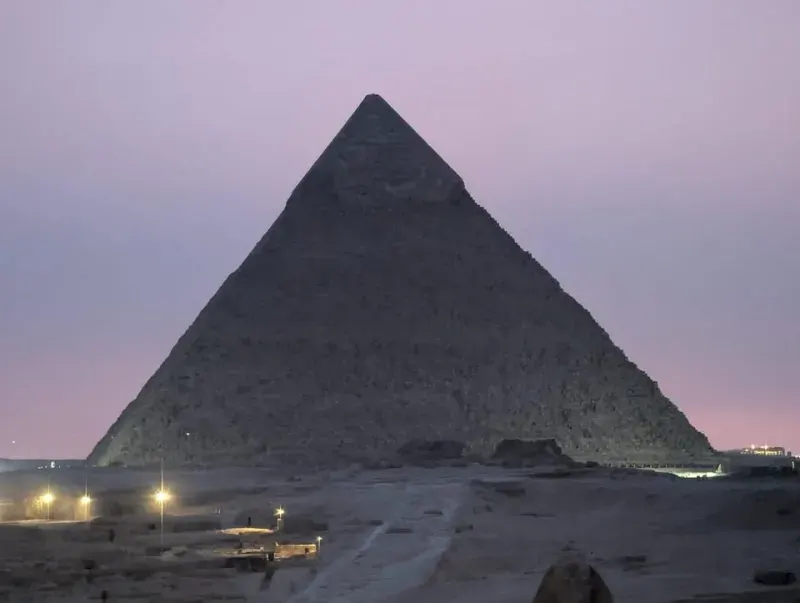
Private Pyramids Tour to Saqqara, Dahshur & Giza with a German-speaking Egyptologist. Discover the evolution of the pyramids – no shopping stops. Free consultation.
From
This private pyramid tour suits travellers who do not simply want to stand in front of the Great Pyramid, but want to understand how Egyptian architects reached that point.
Visit only Giza and you see the finished result.
Visit Saqqara and Dahshur first and you also see the ideas, experiments and adjustments that came before.
Why This Background Changes the Way You See Giza
After Saqqara and Dahshur, the Great Pyramid looks different.
It is no longer simply a giant triangle made from limestone.
You see generations of experience behind it.
Djoser’s builders first had to learn how to create monumental stone architecture on that scale.
At Meidum, a stepped pyramid was pushed towards a smooth outer form.
The Bent Pyramid shows that an ambitious angle had to be changed during construction.
The Red Pyramid shows a successful true-pyramid design.
Khufu’s builders then used all of that knowledge on an extraordinary scale.
Ancient Egyptians did not wake up one morning and decide to build the largest structure of their age.
They tested.
They built.
They learned.
They changed plans.
And they built again.
That is a large part of the story behind the Pyramids of Giza.
The Great Pyramid of Khufu: The Largest Monument at Giza
Among the three Pyramids of Giza, the Great Pyramid of Khufu is the largest, oldest and most famous.
It was built during the Fourth Dynasty for Pharaoh Khufu, known in Greek as Cheops.
His reign is usually placed around 2589 to 2566 BC.
The pyramid originally stood roughly 146.5 metres high and remained the tallest human-made structure on Earth for around 3,800 years.
Today it is lower.
Its top and almost all of the original outer casing are gone.
It still dominates the plateau.
From a distance, the shape looks almost simple.
Four sides.
One summit.
A great deal of limestone.
Stand directly beside it and the scale changes.
Individual stone courses become obvious. Some blocks reach chest height or higher. The summit is so far above you that photographs taken from close range quickly become mostly stone.
The Great Pyramid is a useful reminder that “large” and “really large” are two different things.
How Large Is the Great Pyramid?
Its original height was around 146.5 metres.
Today, it stands at roughly 138 metres.
Each side of its square base measures around 230 metres.
The structure is often estimated to contain around 2.3 million blocks.
That should not be understood as somebody in 2500 BC numbering every block and leaving behind a convenient spreadsheet.
It is a modern estimate.
Most blocks are local limestone.
Higher-quality material was used where required. The King’s Chamber and parts of the internal structure contain large granite blocks brought from the Aswan area in southern Egypt.
Just imagining that transport is impressive.
The stone had to be:
quarried,
shaped,
moved,
taken towards the Nile,
transported by boat,
unloaded,
pulled across the building site,
and placed in the correct position.
Not once.
Again and again.
For years.
How Accurately Is the Great Pyramid Aligned?
One of the pyramid’s most remarkable features is its orientation.
Its four sides are aligned very closely with the cardinal directions.
The builders did not need satellites, laser equipment or GPS.
Ancient Egyptians could observe the sun, stars and shadows and use surveying tools to establish accurate lines.
The exact method used at the Great Pyramid is still debated.
Several techniques have been suggested.
They include observations of particular stars and solar measurements.
Two different facts need to be separated.
We can measure how accurately the pyramid is aligned.
We do not know with complete certainty exactly which method the builders used to achieve that accuracy.
That does not make the achievement mysterious.
It makes it more interesting.
How Level Is the Base?
Preparing the building site was itself a huge project.
Before large stone courses could rise, the monument needed a stable and level base.
With sides around 230 metres long, a small error could grow into a serious problem across the entire structure.
Builders had to:
prepare the rock,
measure elevations,
establish corners,
create right angles,
and align all four sides.
Modern visitors see only the finished monument.
The hardest part of a project often begins well before the building looks impressive.
Nobody takes holiday photographs of a carefully prepared foundation.
The building above it would not exist without one.
What Did the Great Pyramid Look Like Originally?
Its modern surface is rough.
That was not the finished appearance.
The pyramid core was covered in fine, pale limestone casing blocks, much of it quarried at Tura across the Nile.
The finished casing created a much smoother surface.
Under the Egyptian sun, the monument would have appeared very bright.
A pyramidion, or capstone, probably finished the summit.
We do not know exactly what Khufu’s pyramidion looked like or how its visible surface was treated.
Almost all of the casing has disappeared.
Some stone loosened naturally.
Much was later removed and reused as building material.
The visible core blocks are therefore closer to the inside of the original outer structure.
The ancient monument looked smoother and brighter.
Can You Go Inside the Great Pyramid?
Yes, when the interior is open and you have the correct extra ticket.
The experience is very different from entering a tomb in the Valley of the Kings.
Do not expect:
colourful wall paintings,
long hieroglyphic texts,
painted gods,
golden burial objects,
or decorated sarcophagi.
The interior is surprisingly plain.
Its impact comes from the architecture, confined spaces and the vast quantity of stone surrounding you.
You move through narrow passages and steep sections and eventually reach rooms buried deep inside one of the heaviest buildings ever created.
For colourful decoration, the Valley of the Kings is stronger.
For the experience of standing inside a massive Old Kingdom pyramid, Giza offers something very different.
Which Entrance Do Visitors Use?
The original entrance lies on the north side.
Visitors normally enter using a lower tunnel cut into the pyramid at a later date.
This tunnel is traditionally associated with the Abbasid caliph al-Ma'mun and work carried out in the ninth century, although not every detail of that story is certain.
It is safer to say that the modern visitor route uses a later tunnel traditionally linked with al-Ma'mun.
From there you reach the ancient passage system.
That is where the more physical part begins.
The Descending Passage
An original passage slopes steeply downwards from the north side.
It first runs through the body of the pyramid and later into the natural rock beneath it.
At the bottom lies an unfinished underground chamber.
Its original intended purpose is not certain.
It may belong to an earlier stage of planning or a changed burial design.
Such explanations remain hypotheses.
This is something you will notice repeatedly inside the Great Pyramid:
We know the room exists.
We can measure it.
We can study how it was built.
The original architect did not leave us a labelled visitor leaflet.
The Ascending Passage
A narrow ascending passage branches away from the lower system.
It leads upwards towards the main chambers.
For visitors, this section can be tiring.
It is:
narrow,
sloping,
low in places,
and quickly warm when busy.
People with strong claustrophobia, knee problems or limited mobility should think carefully before entering.
The interior is not a place where you walk ten metres and suddenly find a wide side door leading to a café.
You also need to manage the return journey.
The Grand Gallery
Then the space changes dramatically.
After narrow passages, the Grand Gallery opens above you.
It is nearly 47 metres long and slopes upwards under a high corbelled ceiling.
The change in scale is striking.
A moment earlier, you are moving through a confined passage.
Then you enter a space that suddenly rises far above your head.
The exact function of the Grand Gallery remains debated.
It may have played a role in construction, movement or storage of blocking stones, or access to the King’s Chamber.
Different models are still studied.
It is better not to say:
“The Grand Gallery was definitely built for this.”
A more accurate approach is:
Researchers are still studying the roles it may have played during construction and burial.
At the Great Pyramid, a question mark is sometimes more useful than an exciting certainty.
The So-Called Queen’s Chamber
A horizontal passage leads to a room traditionally known as the Queen’s Chamber.
The name is misleading.
There is no strong evidence that a queen was ever buried there.
The room lies inside the pyramid and has a distinctive gabled roof.
Its original function remains uncertain.
Suggestions include religious or symbolic use and the possibility that it was connected with an earlier burial plan.
We know the modern name.
We know the room.
We do not know what Khufu’s builders called it.
“Queen’s Chamber” is therefore a historical label, not a proven explanation.
The King’s Chamber
At the end of the main upper route lies the King’s Chamber.
Here, the material changes.
The room is built from large blocks of red granite transported from the Aswan region.
A simple granite sarcophagus still stands inside.
No gold decoration.
No painted figures.
No long inscriptions.
Travellers expecting something like Tutankhamun’s tomb may be surprised.
Old Kingdom pyramids belong to a different period and different architectural and religious traditions.
The walls do not need colour to create an atmosphere.
You are standing in the centre of a building that has been above you for more than four thousand years.
That does much of the work.
Why Has the King’s Chamber Not Been Crushed?
Several small spaces lie above the King’s Chamber.
They are commonly known as relieving chambers.
Massive granite beams separate these levels, while the uppermost section uses a gabled arrangement of large stones.
The construction helps direct the enormous weight away from the chamber.
Normal visitors see little of this during the standard route.
For engineers and archaeologists, it is one of the most interesting parts of the building.
Creating an open room inside such a mass of stone is impressive.
Making sure it does not collapse under everything above it is another problem entirely.
Was Khufu Really Buried Here?
The Great Pyramid is understood as the royal tomb of Khufu.
His mummy was not found inside.
The original burial equipment is also gone.
That does not mean the pyramid was never used as a tomb.
Royal tombs across Egypt were looted in antiquity.
Archaeologists study the entire context:
location,
pyramid complex,
mortuary temple,
royal names,
inscriptions,
related monuments,
and the development of royal burial practices.
The argument “no mummy was found, therefore it was not a tomb” is far too simple.
What Are the So-Called Air Shafts?
Narrow shafts run from the King’s Chamber and Queen’s Chamber into the pyramid.
Some connect towards the outside, while others terminate inside the structure.
They were once commonly described simply as ventilation shafts.
Their role may have been more complex.
Possible practical functions are discussed alongside religious or symbolic ideas, including connections between the dead king, the heavens and particular regions of the sky.
Once again:
There are interesting theories.
There is no surviving construction drawing labelled “purpose of this shaft”.
ScanPyramids: Studying the Pyramid Without Breaking It Open
The Great Pyramid is still being investigated.
Researchers face an obvious problem.
They cannot simply break through walls to see what lies behind them.
Modern projects therefore use non-destructive methods.
One of the best known is ScanPyramids, which has used cosmic-ray muons.
Muons are particles created when cosmic radiation interacts with Earth’s atmosphere.
They can pass through large amounts of stone.
Detectors measure how many travel through different parts of the pyramid.
A hollow area contains less dense material than solid stone.
That difference can appear in the readings.
Put simply:
Researchers are not producing a normal X-ray.
They are using particles that naturally pass through our environment to measure differences in density.
What Is the “Big Void”?
In 2017, an international research team announced the detection of a previously unknown large void above the Grand Gallery.
Three independent muon-detection methods identified it.
The measured space is at least around 30 metres long.
It is commonly called the ScanPyramids Big Void.
The word “void” matters.
It means an empty or less-dense space.
It does not automatically mean:
secret tomb,
treasure chamber,
second King’s Chamber,
undiscovered royal burial,
or a room full of gold.
Researchers detected a large area with lower density.
Its exact shape and purpose are still being studied.
That may sound less dramatic than “secret chamber discovered”.
Scientifically, it is far more useful.
We have a measured structure and a genuine unanswered question.
The Corridor Behind the North Face
ScanPyramids also detected another structure behind the chevron-shaped stonework on the north face.
In 2023, researchers described a corridor-like void at least five metres long in greater detail.
Later non-invasive research continued to investigate the structure.
This is not simply an internet story about a mystery room.
The corridor has been scientifically detected and studied.
Its original purpose remains open.
It may relate to weight distribution, an earlier or planned entrance, or another structural function.
Until stronger evidence appears, that is where we should stop.
An unknown purpose is not an empty space waiting for any theory we happen to like.
Are There Still Secret Chambers?
There may be other unknown spaces or structures.
Modern research has shown that even the world’s most studied pyramid still contains areas that are not completely understood.
That does not mean treasure is waiting behind every wall.
Archaeological research moves carefully.
First comes measurement.
Then repetition.
Then comparison of possible explanations.
Only after enough evidence appears can a strong conclusion be made.
The pyramid has waited 4,500 years.
It seems comfortable with the pace.
Is Going Inside the Great Pyramid Worth It?
That depends on what you want from the visit.
The Interior Is Worth Considering If You:
enjoy architecture,
want to experience the Grand Gallery,
want to stand inside the Great Pyramid,
cope well with enclosed spaces,
and can manage steep passages.
You May Prefer to Skip It If You:
have strong claustrophobia,
have knee or back problems,
want to avoid steep narrow passages,
expect colourful tomb decoration,
or would rather use the time for the Sphinx, Panorama Point and other areas.
Going inside is not compulsory.
You have not “visited Giza incorrectly” because you stayed outside.
Some travellers find the Grand Gallery one of the strongest parts of the day.
Others emerge mainly pleased to see fresh air again.
Both reactions are reasonable.
How Much Extra Time Should You Allow?
Do not count only the minutes spent inside the King’s Chamber.
You also need time for:
ticket checks,
possible queues,
walking to the entrance,
slow two-way traffic,
climbing,
short rests,
and the return route.
When the pyramid is busy, movement through narrow passages can become slow.
The interior visit should therefore be treated as a proper part of your Giza schedule.
Not:
“We will quickly go inside for ten minutes.”
The pyramid waited several thousand years to reach your travel list.
It can have more than ten minutes.
Visiting the Great Pyramid on a Day Trip from Hurghada
Cairo is a long day from Hurghada.
Many travellers therefore combine the Giza Plateau with major Cairo sights such as the Great Sphinx and the Grand Egyptian Museum.
On a private tour, decide in advance whether you want the extra ticket for the Great Pyramid interior.
Going inside takes additional time and should not be squeezed into an already full programme without planning.
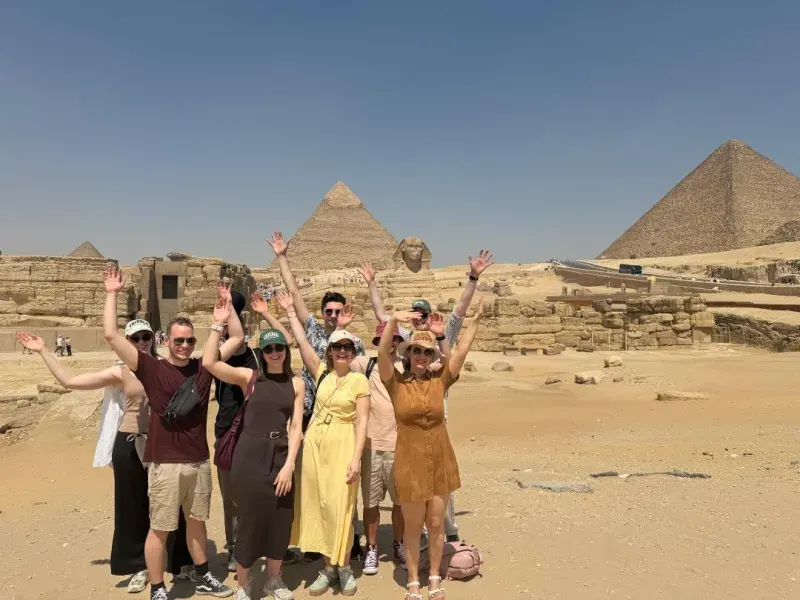
Private Cairo tour in a small group with a German-speaking Egyptologist. Explore the Pyramids, the Sphinx & the Grand Egyptian Museum (GEM) – modern vehicles, no shopping stops.
From
This tour suits travellers who want to combine the Pyramids of Giza, the Sphinx and the Grand Egyptian Museum in one day from Hurghada. Mention the Great Pyramid interior when booking so the schedule and ticket requirements can be checked.
The Great Pyramid Is Interesting Because We Know a Lot – and Not Everything
The Great Pyramid does not need aliens, energy fields or lost super-technology to be interesting.
The real building is enough.
We know who ordered its construction.
We understand much of the internal structure.
We can identify the stone.
We can measure its dimensions with great accuracy.
We know about worker settlements, quarries and parts of the transport system.
At the same time, real questions remain.
Not every construction stage is known.
The exact purpose of some spaces and shafts is still discussed.
Modern measurements have found additional voids whose original roles remain under study.
That mixture makes the Great Pyramid interesting.
It is not a total mystery about which nothing is known.
It is not a fully explained building in which every question has been closed.
It sits somewhere between the two.
After more than 4,500 years, that is quite an achievement.
Khafre, Menkaure and the Great Sphinx: More Than the Great Pyramid
The Great Pyramid receives much of the attention at Giza.
That makes sense.
It is the largest of the three and the last surviving Wonder of the Ancient World.
Visitors who focus only on Khufu miss a large part of the archaeological story.
Two other royal pyramid complexes stand nearby, together with queens’ pyramids, temples, causeways, tombs and the Great Sphinx.
Khafre’s complex is especially useful for understanding that a pyramid never stood alone.
The Pyramid of Khafre: Why Does It Sometimes Look Larger?
From some viewpoints, Khafre’s pyramid looks like the largest of the three.
It is not.
Its original height was around 143.5 metres, slightly lower than the Great Pyramid.
It stands on higher ground, which can make it appear taller from a distance.
Perspective strengthens the effect in photographs.
To compare the pyramids properly, move around the plateau and look from different positions.
A few steps can completely change the apparent size.
Why Does Khafre’s Pyramid Still Have a Smooth Top?
Khafre’s pyramid is easy to recognise.
Part of its original outer casing survives near the summit.
These finely dressed limestone blocks once covered much more of the monument.
They help you imagine what all three pyramids originally looked like.
The rough stone courses we now see were not intended as the final outer face.
The pyramids once appeared much smoother.
Khafre’s surviving casing is like a small surviving section of the ancient finish.
What Belonged to Khafre’s Complex?
The complex included:
the main pyramid,
a mortuary temple,
a long causeway,
a valley temple,
other burial structures,
and the area of the Great Sphinx.
The mortuary temple stood close to the pyramid.
The valley temple lay lower down and connected to the upper complex through the causeway.
Khafre’s Valley Temple is particularly well preserved.
Its heavy stone construction, granite surfaces and massive columns help show how elaborate these royal complexes were.
It is not simply a side building to ignore while walking towards the Sphinx.
Menkaure’s Pyramid: The Smallest of the Three
Farther south-west stands the pyramid of Menkaure.
It is much smaller than Khufu and Khafre.
Its original height was around 65 metres.
Next to the Great Pyramid, it can look almost modest.
The word “small” needs context at Giza.
A 65-metre stone pyramid would be enormous almost anywhere else.
It simply has the bad luck of living beside two very large neighbours.
Why Is Menkaure’s Pyramid Different?
The lower part used granite casing.
This stone came from the Aswan region far to the south.
The upper sections were intended to use limestone.
Some granite blocks are still visible.
Some were polished.
Others were left unfinished.
This may reflect the fact that Menkaure died before every part of the complex was completed.
Different stages of work remain visible.
In places, you can almost imagine the builders intending to return the next morning.
Their lunch break has now lasted more than four thousand years.
What Are the Small Pyramids Beside the Main Ones?
Several smaller pyramids stand beside the main royal monuments.
They are often called queens’ pyramids.
Three small pyramids stand beside Menkaure’s complex.
Other subsidiary pyramids exist around Khufu’s monument.
These show that royal burial at Giza involved more than one person.
Members of the royal family, senior officials and the wider royal cult all left physical traces on the plateau.
The smaller pyramids are not decorative miniatures made for visitors.
They form part of the original necropolis.
The Great Sphinx of Giza
The Great Sphinx of Giza is almost as famous as the pyramids.
It was carved directly from the natural rock of the plateau.
The monument combines the body of a reclining lion with a human head.
The form was closely connected with kingship.
The lion represented strength.
The human head expressed royal identity and authority.
The strongest archaeological evidence links the Great Sphinx with Khafre’s reign and pyramid complex.
That matters because countless modern stories surround the monument.
Some are scientifically interesting.
Others work better in films than in travel guides.
Does the Face Show Khafre?
The main archaeological interpretation connects the Sphinx with Khafre.
Its position beside his Valley Temple and at the lower part of his causeway supports that relationship.
Research into the sequence of construction and comparisons with royal images also form part of the argument.
It is still better not to write:
“We know with complete certainty that the face is Khafre.”
A more accurate wording is:
The strongest archaeological evidence connects the Great Sphinx with Khafre’s reign and pyramid complex.
That leaves room for genuine academic discussion without treating every alternative theory as equally strong.
Why Does the Sphinx Have a Lion’s Body?
The lion was a strong symbol of royal power.
A ruler with a lion’s body was therefore not a strange fantasy creature to ancient Egyptians.
The image sent a clear message:
Royal strength is here.
The Sphinx also guarded the necropolis and later became an object of worship in its own right.
During the New Kingdom, it gained a renewed religious identity as Horemakhet, “Horus of the Horizon”.
Later kings worshipped and restored a monument that was already ancient in their own time.
For Thutmose IV, the Sphinx was already part of a distant past.
Imagine standing beside a building that was already ancient during the Roman Empire.
That gives some sense of the timescale.
Why Is the Sphinx Missing Its Nose?
One of the best-known legends says Napoleon’s soldiers shot off the nose during the French campaign in Egypt.
The story is dramatic.
It does not fit the evidence.
Drawings made before Napoleon arrived in Egypt already show the Sphinx without its nose.
His soldiers therefore cannot be responsible.
Exactly when and by whom it was damaged is less certain.
Some historical reports connect the destruction with deliberate damage during the medieval period, but those accounts need cautious treatment.
For most visitors, the useful answer is simple:
Napoleon did not do it.
The Sphinx had already lost its nose.
Napoleon has enough other historical controversies to manage.
What Is the Dream Stele?
Between the front paws of the Sphinx stands a large stone inscription known as the Dream Stele of Thutmose IV.
It was erected in the New Kingdom, more than one thousand years after the Sphinx was created.
The text tells an unusual story.
The young prince is said to have rested near the Sphinx while it was partly buried in sand.
He fell asleep.
In the dream, the Sphinx spoke to him.
It promised him kingship if he cleared away the sand.
Thutmose later became pharaoh and placed the stele between the paws.
We cannot check whether the dream happened exactly as described.
The stele itself is real.
It shows that the Sphinx had major religious importance in the New Kingdom and that rulers were already trying to clear sand from around it.
Was the Sphinx Completely Buried in Sand?
Not permanently.
Over long periods, large parts of the body became covered by windblown sand.
The head remained visible for much longer because it stood higher.
Later rulers and later generations repeatedly carried out clearance work.
The Sphinx therefore had an unusual problem for thousands of years:
It had to be excavated repeatedly even though everybody knew where it was.
Photographing the Sphinx and Pyramids
The Sphinx area provides some of the most famous photo angles on the plateau.
Depending on your position, you can photograph:
the Sphinx alone,
Khafre’s pyramid behind the head,
several pyramids in the distance,
facial details,
or the nearby temple structures.
Perspective matters.
Those photographs where someone appears to kiss the Sphinx or hold a pyramid between two fingers work only from particular spots.
Several other visitors usually have exactly the same idea.
You will probably not be the first person that morning to try to kiss a 4,500-year-old lion.
Which Pyramids Should You Pay Attention To?
Each main pyramid tells a different part of the story.
Khufu
Look at it for:
scale,
history,
its status as the surviving ancient wonder,
and the possibility of entering the interior.
Khafre
Notice:
surviving casing,
higher position,
the Valley Temple,
and the connection with the Sphinx.
Menkaure
Look for:
its different proportions,
granite casing,
queens’ pyramids,
and signs of an unfinished complex.
The smallest pyramid should not automatically receive the shortest amount of attention.
Details can sometimes be easier to notice there than beside the enormous mass of Khufu.
Visiting Giza by Air from Hurghada
Travellers staying on the Red Sea can reach Cairo by domestic flight.
This may suit people who prefer to avoid a very long road day while still seeing the Pyramids of Giza, the Sphinx and the Grand Egyptian Museum.
Flights do not remove the need for planning.
Airport transfers, check-in, flight schedules and Cairo traffic still take time.
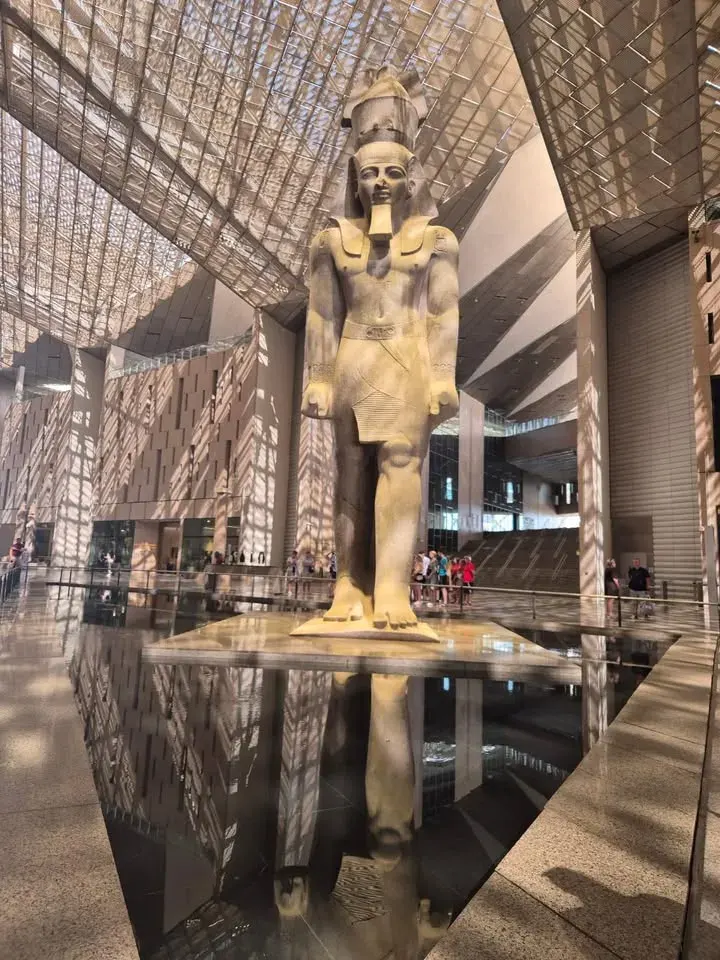
Fly to Cairo in a private small group with a German-speaking Egyptologist. Explore the Pyramids, the Sphinx & the Grand Egyptian Museum (GEM) – no shopping stops. Free consultation.
From
A private Cairo day trip by air allows the time at Giza, the Sphinx and the museum to be planned in advance. Mention the Great Pyramid interior when booking if it is important to you.
Why Khafre, Menkaure and the Sphinx Matter
Khufu shows how far Egyptian builders could take pyramid construction.
Khafre shows how pyramid, temple, causeway and royal image could form one connected complex.
Menkaure shows that pyramid development was not simply a competition to build ever larger.
The Sphinx connects architecture with kingship, religion and more than a thousand years of later worship.
Together, these monuments turn Giza into more than a site with three famous triangles.
They create a royal landscape.
That brings us to the most common question of all:
How were the Pyramids of Giza built?
How Were the Pyramids of Giza Built?
Few questions about the Pyramids of Giza produce wild theories as quickly as the construction question.
Millions of stone blocks.
Huge granite beams.
Very accurate surveying.
No modern cranes.
No lorries.
No electrical tools.
The question is understandable:
How could people more than 4,500 years ago build this?
The best answer is:
We understand many parts of the building process quite well.
We know where large groups of workers lived. We know quarries. Archaeologists have found tools, work traces and administrative records. Stone travelled by water, and sledges and ramps formed part of ancient Egyptian building technology.
What we do not possess is one complete construction manual for the Great Pyramid showing every ramp, lifting stage and movement.
That is the difference between research and speculation.
Unanswered details do not make the entire project unexplained.
Were the Pyramids Built by Slaves?
The familiar image of thousands of chained slaves dragging stones under whips is one of the most persistent stories about Giza.
The archaeological evidence does not fit that simple picture.
South of the Sphinx, archaeologists uncovered a large Fourth Dynasty settlement linked with pyramid workers.
Excavations revealed:
living areas,
large galleries,
streets,
storage spaces,
administrative buildings,
food-production areas,
and cemeteries for workers and supervisors.
Animal remains show that large quantities of meat, fish and other food were supplied.
That does not mean every worker had a modern employment contract, annual leave and a human-resources department.
Ancient Egyptian society used state labour obligations, temporary labour and specialist craft work.
The more accurate conclusion is:
The evidence supports an organised workforce rather than the simple Hollywood image of a huge slave army.
Who Worked on the Building Site?
A pyramid was not built only by men pulling stones.
A project of this scale required many jobs.
These probably included:
stonecutters,
quarry workers,
hauliers,
boat crews,
carpenters,
rope makers,
surveyors,
scribes,
supervisors,
cooks,
bakers,
supply workers,
craftsmen,
and administrators.
Other people had to supply food, tools and raw materials.
The project operated more like a huge state organisation than a single construction gang.
The pyramid shows the final result.
The workers’ settlement shows what had to exist behind it.
Someone needed to feed thousands of people every day.
A stone block does not move faster because the lunch break was forgotten.
How Many People Built the Great Pyramid?
We need to be cautious here.
Older accounts sometimes proposed 100,000 workers or more.
Modern estimates are generally much lower, and the number may have changed through different building phases.
There is no single figure we can state with complete certainty.
Not everyone worked on the same job at the same time.
One group might quarry stone while others:
transported blocks,
dressed casing stones,
prepared ramps,
maintained tools,
delivered food,
or worked on temples and other parts of the complex.
The workforce probably changed during the project.
“How many people built the pyramid?” sounds like a simple question.
It is a bit like asking:
“How many people build an airport?”
Do you mean everyone employed at once?
Everyone involved over the entire project?
Only construction workers?
Or engineers, drivers, suppliers, catering staff and administration too?
After 4,500 years, the answer at Giza is not getting easier.
Where Did the Limestone Come From?
A large amount of the core limestone could be quarried directly on the Giza Plateau.
That was a major logistical advantage.
Not every block needed a long journey.
Higher-quality stone was required for the outer casing.
Fine white limestone came from Tura on the east side of the Nile.
This brings us to one of the most useful pieces of direct evidence from Khufu’s reign.
The Diary of Merer: A Real Ancient Work Record
In 2013, papyrus fragments dating to Khufu’s reign were discovered at the ancient harbour of Wadi el-Jarf.
Some form what is known as the Diary of Merer.
Merer supervised a work crew.
His records describe journeys in which his team transported limestone from Tura towards Giza while the Great Pyramid was under construction.
These texts are among the oldest surviving papyrus records from Egypt.
For pyramid research, that is extremely useful.
This is not a later legend.
It is administration from the period of the project itself.
Merer does not write:
“Today we reveal the lost secret of the pyramids.”
His notes are much more ordinary.
They deal with crews, journeys, supplies and work routines.
For historians, ordinary paperwork is excellent.
Spectacular stories may sell more books.
An old work diary often tells us much more about how a building project actually operated.
Was Stone Really Transported by Water?
Yes.
Merer’s records directly support the movement of Tura limestone by boat towards Giza.
The ancient landscape was very different from the present one.
A modern map shows the Nile some distance from the plateau.
That was not the complete Old Kingdom landscape.
Research has reconstructed a now-lost major Nile branch running close to many pyramid fields.
Harbour zones, channels and water access existed much nearer the Giza complexes.
That changes the picture.
The pyramids were not simply built in dry desert while every stone was dragged for kilometres across sand.
Water could bring people and material much closer to the site.
Why Did the Causeways Lead Towards Valley Temples?
The long causeways connected the upper pyramid areas with valley temples at lower ground.
They served both religious and practical purposes.
Research into the ancient landscape shows that valley temples were closely linked to old waterways and harbour areas.
That makes the layout more understandable.
Boats could deliver people and materials.
From the landing areas, causeways and prepared routes led towards the plateau.
Today, you see roads, buildings and dry desert.
During the Old Kingdom, water and harbour landscapes were a much larger part of the scene.
How Were Heavy Blocks Moved Over Land?
Wooden sledges provide a well-supported method for moving heavy loads.
Ancient Egyptian images show large objects being pulled on sledges.
A famous scene from the tomb of Djehutihotep depicts a huge statue being hauled while a person pours liquid onto the ground in front of the runners.
Modern experiments explain why that can help.
The correct amount of water can make sand firmer and reduce the force needed to pull a heavy sledge.
Too much water reduces the benefit.
That does not prove every block of the Great Pyramid followed the exact same route.
It shows that a simple ancient technique works physically:
Sledges.
Ropes.
People.
And properly prepared sand.
No floating stone is required.
You do need strong organisation and many people pulling in the same direction.
How Did the Blocks Get Higher?
This remains one of the main open questions.
Most archaeological models involve ramps.
The basic idea is straightforward:
Blocks are not lifted vertically from ground level.
They are moved upwards along inclined surfaces.
The exact ramp layout is still debated.
Suggested models include:
straight ramps,
side ramps,
zigzag systems,
ramps running along pyramid faces,
combinations of different ramp designs,
and systems that changed as the building became taller.
The issue is not whether ancient Egyptians understood ramps.
They clearly used inclined structures in building.
The harder question is:
Which ramp system was used at which stage of the Great Pyramid?
There is no single answer accepted by everyone.
Why Is One Giant Straight Ramp Difficult?
A straight ramp reaching almost to the top sounds simple.
As the pyramid grows, the ramp would need to become very long or very steep.
A shallow ramp would consume huge amounts of material and space.
A steep ramp would make heavy transport harder.
That is why researchers study models where ramps changed, moved or worked together.
There may never have been one single “Great Pyramid ramp”.
Different construction stages could use different solutions.
That would not be unusual for a project lasting many years.
Modern high-rise buildings do not use exactly the same machine from foundation to rooftop.
Did the Egyptians Use Pulley Systems?
There is no secure evidence that the Great Pyramid relied on a modern pulley system of the type we recognise today.
Builders did have levers, ropes, timber and sledges.
Simple machines can move enormous loads when enough people, preparation and repetition are involved.
A common mistake is to say:
“One person could not lift this block.”
That is true.
Nobody expected one person to do it.
The project relied on groups, tools and repeated systems.
Nobody expects one modern worker to carry a concrete beam to the twelfth floor either.
Were All 2.3 Million Blocks Perfectly Cut?
No.
The visible precision of the pyramid can be misleading.
Not every core block was finished to the same standard as casing blocks or important interior stonework.
Builders could use the greatest precision where it mattered most:
outer faces,
corners,
chambers,
passages,
load-bearing areas,
and final alignment.
Core masonry could be more irregular.
The Great Pyramid is therefore both extremely precise in key areas and highly practical elsewhere.
That is exactly what you would expect from experienced builders.
They did not use maximum accuracy simply where it looked impressive.
They used it where it was needed.
How Long Did Construction Take?
The exact building period cannot be reduced to a precise day count.
The Great Pyramid was built during Khufu’s reign.
Merer’s diary comes from a later stage of that reign, when high-quality Tura limestone was still being transported towards Giza.
A building period of roughly two decades is often discussed.
Such figures remain reconstructions.
What matters is what they imply.
The project had to function for years.
Not only on one unusually productive Tuesday.
Food, transport, tools, materials and labour had to arrive day after day.
This is why administrative records and worker settlements matter so much.
They explain the pyramid through a functioning system rather than one lost trick.
What Mattered More: Technology or Organisation?
Both.
Egyptian builders needed knowledge of:
stoneworking,
surveying,
structural behaviour,
transport,
waterways,
ramps,
timber,
ropes,
and tools.
The best technical idea still fails when nobody delivers food on Wednesday and nobody knows which stone goes to the harbour on Thursday.
The pyramids are therefore also monuments to administration.
Merer’s records show crews and transport.
Worker settlements show food supply, housing and management.
Old waterways explain how large quantities of material could reach the construction zone.
The pyramid was not created through one single secret.
It was built because many systems worked together.
Did Egyptians Need Unknown Technology?
There is no archaeological reason to require lost high technology or alien assistance.
We have:
quarry traces,
tools,
worker settlements,
ancient waterways,
administrative documents from Khufu’s reign,
evidence for sledges,
and physical experiments showing how heavy loads can be moved over prepared sand.
The main open questions concern the precise combination of techniques.
That is very different from saying:
“We have no idea.”
The real story is stronger.
Thousands of people organised a building site for years, moved stone from several parts of Egypt, managed food and transport and produced a monument that still rises above Cairo 4,500 years later.
Aliens are not required.
A highly organised human society is impressive enough.
What Can You Notice During Your Visit?
When visiting the Pyramids of Giza, do not look only towards the top.
Notice:
different block sizes,
surviving casing stone,
areas cut into natural rock,
temple positions,
causeways,
lower areas towards the former water landscape,
and distances between the complexes.
Giza begins to look less like three isolated monuments.
It becomes a complete building and ritual landscape.
The most interesting question may not be:
“How did they move this single block?”
It may be:
How did they make sure that the correct stone, crew and material arrived at the correct place every day for years?
The answer lies less in a secret machine.
It lies in people, planning, boats, craft skills and organisation.
Why Do the Pyramids Look Different Today?
Visitors now see enormous steps of yellow-brown limestone.
That was not the original finish.
The visible stone is largely the core masonry.
The Great Pyramid was once covered in fine Tura limestone casing that created a smooth, bright surface.
Khafre’s pyramid also had such casing.
A surviving section near the summit gives us a rare glimpse of the original appearance.
Over the centuries, much of the casing disappeared through natural damage and later stone reuse.
When you stand beside the monuments today, imagine an extra outer layer.
Smooth bright surfaces instead of the rough courses familiar from photographs.
As though 146-metre pyramids were not already noticeable enough.
Were the Pyramids Really Royal Tombs?
Yes.
The three main pyramids are understood as royal burial monuments for Khufu, Khafre and Menkaure.
Each formed the centre of a wider funerary complex.
Calling them only “tombs” still misses part of the story.
After a king’s death, his cult continued.
Priests made offerings.
Temples supported rituals.
The dead ruler was expected to continue existing in the next world.
Pyramid complexes therefore combined burial, royal memory and religion.
Mummification and the Hope of Eternal Life
Preserving the body played an important role in ancient Egyptian ideas about life after death.
Mummification developed over many centuries.
It is therefore unwise to take procedures best documented from later periods and assume they were identical during Khufu’s time.
The familiar full process could take around 70 days.
The body was dried using natron before further treatment, wrapping and religious ceremonies.
Organs might be removed and stored separately, while amulets helped protect the dead person.
The central idea remained:
The body needed to survive so the dead person could continue in another form of existence.
For a king, this had both religious and political importance.
The pharaoh’s death was not viewed as a purely private event.
His role continued beyond ordinary life.
Why Were There So Many Statues?
Statues were not simply decoration.
They could form part of funerary worship and provide a lasting image of the dead person.
Offerings and rituals could take place before such representations.
Numerous royal and private statues have been found around Giza.
Tombs belonging to royal relatives and senior officials also show how images of the dead were connected with continued existence and offerings.
The sculptor’s work therefore had a religious role.
That helps explain why ancient Egyptian artists paid such close attention to faces, poses and royal symbols.
Khufu’s Boats: Why Were Ships Buried Beside a Pyramid?
Two large dismantled ships were found in sealed pits south of the Great Pyramid.
Their exact religious and practical roles remain discussed.
They may have been connected with the royal funeral, transport of the king and burial goods, or symbolic journeys linked with the sun god.
The best-known vessel was discovered in 1954.
Its many wooden pieces were eventually reconstructed.
The ship is more than 40 metres long.
For years it stood in a museum beside the Great Pyramid.
That has changed.
The reconstructed Khufu Boat is now associated with the Grand Egyptian Museum, where Khufu’s boats form part of the museum experience.
This is useful when planning a visit.
You can combine the archaeological landscape at Giza with the original boat and other objects at the museum.
The vessel apparently had one more journey left after 4,500 years.
Is Giza and the Grand Egyptian Museum a Good Combination?
Yes, especially when you have a full day in Cairo.
On the Giza Plateau you see:
the monuments in their original landscape,
the Great Pyramid,
Khafre,
Menkaure,
the Sphinx,
temples,
and tombs.
At the Grand Egyptian Museum, you can examine original objects much more closely.
The two experiences support each other.
Giza provides the scale.
The museum provides the details.
Pyramid Myths: What Is Actually True?
The Pyramids of Giza have inspired imagination for centuries.
That is understandable.
When a 4,500-year-old monument still stands and we cannot reconstruct every building stage with complete certainty, dramatic stories quickly appear.
Some do not survive close examination.
Were the Pyramids Built by Aliens?
No archaeological evidence supports that claim.
The evidence we do have points towards human work.
Archaeologists have identified worker settlements, quarries, tools, transport routes and administrative records.
The question of exactly which ramp worked at which stage remains interesting.
It does not create a need for visitors from another solar system.
The actual builders left archaeological evidence.
Aliens have not.
Were They Built by Slaves?
The simple movie image of a huge chained slave workforce does not match the excavated evidence.
The worker settlement at Giza belonged to an organised labour system.
Residential areas, administration, food supply and worker cemeteries have all been found.
This does not mean Old Kingdom labour followed modern employment rights.
State labour duties and seasonal work were part of ancient society.
The evidence still points towards organised and supplied workers, including skilled craftsmen, rather than a giant anonymous slave army.
Are There Secret Chambers?
There are genuinely unexplained spaces within the Great Pyramid.
Modern ScanPyramids research has identified areas such as the Big Void and the North Face Corridor.
“Void” should not automatically become “secret treasure chamber”.
We know certain structures exist.
Their original functions remain partly open.
That is already interesting.
An unknown space does not need a box of gold to matter scientifically.
Are Hidden Treasures Still Inside?
There is currently no strong evidence for untouched treasure hidden inside the Great Pyramid.
The granite sarcophagus remains in the King’s Chamber, but Khufu’s mummy and original burial goods were not found there.
An unknown void does not automatically contain royal treasure.
Indiana Jones can remain at the hotel for now.
Practical Visitor Information for the Pyramids of Giza in 2026
History matters.
On the day of your visit, practical questions become just as important.
When does the site open?
Which ticket do you need?
Can you enter the Great Pyramid?
How long should you stay?
And how do you avoid spending your best pyramid view in a queue?
Pyramids of Giza Opening Hours in 2026
Published opening times can differ between the wider Giza Plateau and individual monuments such as the Great Pyramid.
For that reason, check your exact visit date using the official ticket system before travelling.
Pay attention to:
the general plateau opening time,
your booked time slot,
any separate pyramid-interior ticket,
and final entry times.
The time on your ticket confirmation is more useful than a general timetable copied from an old travel article.
Pyramids of Giza Entry Tickets
The standard plateau ticket covers access to the archaeological site and the public outdoor areas around the main pyramids and Sphinx.
Separate tickets are normally needed for certain interiors and additional monuments.
These may include:
the Great Pyramid,
Khafre’s pyramid when open,
Menkaure’s pyramid when open,
selected tombs,
and other separately ticketed areas.
Prices can change.
Check the official booking system shortly before purchasing rather than relying on an old screenshot.
What Does the Standard Plateau Ticket Include?
The basic ticket gives access to the archaeological grounds and the external areas around the major monuments.
That normally allows you to see:
the Great Pyramid from outside,
Khafre’s pyramid from outside,
Menkaure’s pyramid from outside,
the Great Sphinx,
public viewpoints,
and open parts of the wider archaeological site.
Interior access is different.
Plan first what you actually want to see.
Outside only?
Inside the Great Pyramid?
An extra tomb?
Grand Egyptian Museum on the same day?
Then buy the appropriate tickets.
Not the other way around.
Is Going Inside the Great Pyramid Worth It?
The interior suits visitors who:
enjoy architecture,
want to see the Grand Gallery,
can handle narrow spaces,
can manage steep passages,
and want to stand inside the Great Pyramid itself.
Remember:
There are no brightly painted scenes like those in the Valley of the Kings.
The King’s Chamber is plain.
The route itself is a large part of the experience.
If you have strong claustrophobia, knee trouble or difficulty with steep confined spaces, the outside visit may be the better option.
You do not need to crawl through a pyramid to prove you have visited Giza.
The exterior does quite enough on its own.
How Much Time Do You Need at Giza?
Allow around four to six hours for a comfortable first visit to the plateau.
More time is useful if you:
enter the Great Pyramid,
visit additional tombs,
take lots of photographs,
use a guide,
take breaks,
or explore at a slower pace.
If you combine Giza with the Grand Egyptian Museum, treat the day as a full sightseeing day.
The two attractions are geographically close.
They are both large.
“We will quickly look around the museum afterwards” can turn into a very long version of “quickly”.
A Good First-Time Giza Route
A practical order can look like this:
1. Great Pyramid
Begin with Khufu.
See the exterior first and enter afterwards when you have an interior ticket.
2. Pyramid of Khafre
Look for the remaining casing near the summit.
This area also shows how the plateau rises.
3. Menkaure and the Smaller Pyramids
This section helps you compare the proportions of all three royal complexes.
4. Panorama Viewpoint
Stop where several pyramids can be seen together.
5. Sphinx and Valley Temple
Finish near the Great Sphinx.
From here, the relationship with Khafre’s pyramid and Valley Temple is easier to understand.
During very hot weather, slow the route down and add more shade and water stops.
Visiting Giza from Hurghada
Cairo is a long journey from Hurghada.
Travellers with several days available may prefer to combine Giza with more of Cairo or Alexandria rather than spend most of one day on the road.
2-day Cairo & Alexandria tour by flight in a private small group with a German-speaking Egyptologist. Explore the Pyramids, the Grand Egyptian Museum (GEM) & Alexandria – no shopping stops. Free consultation.
From
This private route combines the Pyramids of Giza and the Grand Egyptian Museum with more time in Cairo and Alexandria. It suits travellers who want a broader northern Egypt experience rather than one very long single-day visit.
Best Time of Year to Visit the Pyramids
The cooler period from autumn to spring is more comfortable for long outdoor visits.
Summer can become extremely hot on the open plateau, where shade is limited.
When travelling during the hotter months:
start early,
drink regularly,
use sun protection,
wear a hat,
and schedule breaks.
The pyramids certainly create large shadows.
They rarely place them exactly where you happen to be standing.
Best Photography Spots at the Pyramids of Giza
Giza is one of the world’s most photographed archaeological sites.
Your images can still look very different depending on where you stand.
Panorama Point
The western or south-western area of the plateau provides the classic view of several pyramids together.
It works well for:
wide-angle photographs,
group photos,
comparing pyramid sizes,
and including the desert landscape.
Your exact position matters.
One step sideways can suddenly hide one pyramid behind another.
Giza occasionally requires more geometry than expected.
The Sphinx with Khafre Behind It
The Sphinx area gives one of Giza’s classic compositions.
From selected positions, Khafre’s pyramid rises directly behind the Sphinx.
The surviving casing at the top remains visible and the archaeological relationship between the monuments makes the view historically meaningful as well as photogenic.
Close to the Great Pyramid
From close range, you will not get the classic complete triangle.
You will see the size of the blocks.
Place a person some distance in front and the scale becomes obvious.
That can produce a stronger picture than another perfect pyramid on the horizon.
Can You Take Photographs on the Plateau?
Private photography is generally permitted in many archaeological areas, subject to current local rules.
Special conditions may apply to:
professional equipment,
commercial photography,
large lighting equipment,
restricted interiors,
and organised film production.
Always follow the current signs and staff instructions.
Drones should not be treated like an ordinary camera.
Use them only with the required Egyptian permissions.
Put simply:
A mobile phone for holiday photos?
Usually straightforward.
A full film crew with lights, tripod and drone?
That is a different conversation.
Camel and Horse Rides: What Should You Check?
Camel and horse rides are offered around parts of the plateau.
When booking, agree on the full price before starting.
Ask clearly:
How long is the ride?
Where does it begin?
Where does it finish?
Is the price per person or per animal?
Are photo stops included?
Are there extra charges?
How do you return afterwards?
“Good price, my friend” is not a tariff.
Ask for an actual number.
Also look at the condition of the animal.
Avoid animals that appear:
injured,
badly rubbed by equipment,
exhausted,
or poorly treated.
You do not need to ride an animal to have a complete pyramid visit.
Panorama views also work perfectly well on your own two feet.
Safety and Behaviour at Giza
Giza is an archaeological site, not a climbing park.
Follow barriers, signs and staff instructions.
Climbing the pyramids outside officially permitted visitor routes is not part of a normal visit.
Do not remove:
stones,
fragments,
or material from protected archaeological areas.
Respect:
barriers,
closed sections,
tomb walls,
temple stones,
and other visitors.
A 4,500-year-old block does not become more interesting because somebody scratched their initials into it.
What Should You Take?
For a normal visit, pack:
water,
sun cream,
hat or cap,
sunglasses,
comfortable shoes,
light clothing,
your ticket on your phone,
passport or required identification,
student ID when using a reduced ticket,
some cash,
mobile phone,
and a power bank.
Avoid an unnecessarily heavy backpack.
The plateau is large.
What looks like “just some water and my camera” at breakfast can become a personal gym session by the afternoon.
Are the Pyramids Suitable for Children?
Yes.
Giza can be exciting for children because the scale is easy to understand.
A 4,500-year-old pyramid does not need a long lecture before it looks impressive.
With children:
start earlier,
carry enough water,
take regular breaks,
avoid overloading the itinerary,
and think carefully before taking younger children into the Great Pyramid.
Small children do not need to inspect every pyramid from every possible angle.
A relaxed visit to Khufu, a panorama viewpoint and the Sphinx may be more enjoyable than a military march across the whole plateau.
Visiting with Limited Mobility
The plateau is large and includes uneven, sandy and paved surfaces.
Anyone with limited walking ability should not assume that every monument is easy to reach on foot.
Vehicle transport between permitted areas can make the visit much easier.
Pyramid interiors are much more difficult.
Narrow passages, slopes and steep sections make them unsuitable for many visitors with mobility limitations.
The exterior monuments, viewpoints and Sphinx already provide a complete Giza experience without needing to enter a pyramid.
The Pyramids as Part of a Longer Egypt Journey
Giza is an excellent beginning.
It is not the end of ancient Egyptian history.
Travellers with more time can follow Egypt through several periods and regions:
Old Kingdom pyramids,
temples and royal tombs in Luxor,
the Nile south towards Aswan,
and time on the Red Sea.
A longer private Egypt tour combines Cairo and the pyramids with the Nile Valley and Hurghada. This suits travellers who want to see Giza as part of Egypt’s wider historical story rather than as an isolated attraction.
Frequently Asked Questions About the Pyramids of Giza
How Old Are the Pyramids of Giza?
The three main pyramids were built during the Fourth Dynasty of the Old Kingdom, around 4,500 years ago.
Khufu, Khafre and Menkaure all belong to this period.
Which Is the Largest Pyramid?
The Great Pyramid of Khufu is the largest and oldest of Giza’s three main pyramids.
Its original height was around 146.5 metres.
It remained the tallest human-made structure on Earth for roughly 3,800 years.
Why Does Khafre’s Pyramid Sometimes Look Bigger?
Khafre’s pyramid stands on higher ground.
Although it was originally slightly lower than Khufu’s, perspective and elevation can make it appear taller from some viewpoints.
Can You Go Inside the Great Pyramid?
Yes, when the interior is open and you have the required additional ticket.
The general plateau ticket does not automatically include the interior.
What Do You See Inside?
The most famous areas include the ascending passages, the Grand Gallery and the King’s Chamber with its granite sarcophagus.
Do not expect the colourful decoration seen in Luxor’s royal tombs.
Is the Interior Worth Visiting?
Yes, for travellers interested in architecture who can cope with narrow, steep passages.
People with strong claustrophobia or limited mobility can comfortably skip it.
How Long Should You Spend at Giza?
Around four to six hours works well for a relaxed first visit.
Allow longer for the Great Pyramid interior, additional tombs or extensive photography.
What Time Does the Giza Plateau Open?
Opening times can vary between the wider plateau and specific monuments.
Check the official booking system for the exact date and time of your visit.
Do You Need a Separate Ticket to Enter the Pyramids?
Yes.
The normal plateau ticket covers the general archaeological site.
Interior access to individual pyramids normally requires an additional ticket.
Is the Sphinx Included?
The normal public Sphinx viewing area forms part of the Giza archaeological site.
Special access arrangements may have separate rules.
Did Napoleon Destroy the Sphinx’s Nose?
No.
Images created before Napoleon’s arrival in Egypt already show the Sphinx without its nose.
Were the Pyramids Built by Slaves?
The archaeological evidence shows an organised worker settlement with housing, food production, administration and cemeteries.
That does not support the simple story of a huge enslaved workforce.
Are There Secret Rooms Inside the Great Pyramid?
Modern research has detected spaces that are not yet fully explained.
Their existence does not automatically mean treasure chambers or undiscovered royal burials.
Where Is Khufu’s Boat Today?
The famous reconstructed Khufu boat is connected with the Grand Egyptian Museum rather than its former museum beside the Great Pyramid.
Can You Visit the Pyramids and Grand Egyptian Museum on the Same Day?
Yes.
The combination works well for a full Cairo sightseeing day.
Allow enough time for both sites.
The museum is large and deserves more than a rushed final hour.
Can You Climb the Pyramids?
Visitors should use only official access routes and areas opened by the authorities.
Do not cross barriers or climb closed exterior sections.
Are the Pyramids Suitable for Families?
Yes.
Bring water, sun protection and plan regular breaks.
Decide on the Great Pyramid interior according to the child’s age and comfort with confined spaces.
Final Thoughts: Why the Pyramids of Giza Still Fascinate Us
The Pyramids of Giza can look almost simple from a distance.
Three enormous geometric forms stand beside a modern city.
The deeper you look, the larger the story becomes.
Before Khufu came mastabas, Djoser’s Step Pyramid, Meidum, the Bent Pyramid and the Red Pyramid.
At Giza, this development produced complete royal landscapes containing:
pyramids,
temples,
causeways,
boat pits,
tombs,
queens’ pyramids,
and the Great Sphinx.
Builders had to quarry, measure, transport and position stone for years.
The project required more than physical strength.
It needed craftsmen, boats, quarry teams, work crews, scribes, food supply and an administration capable of managing a huge project over many years.
The religious meaning mattered just as much.
The pyramids belonged to a world in which death was not seen as a final ending.
The dead king was expected to continue existing, receive offerings and take his place within the divine order.
Then there are the genuine unanswered questions.
We do not know every building stage.
Researchers still debate the exact ramp systems.
Some spaces inside the Great Pyramid do not yet have a fully explained purpose.
That does not make the pyramids impossible to understand.
It makes them a place where a huge amount of knowledge and several real research questions exist at the same time.
For your own visit, do not come only for the famous photograph.
Stand close enough to see the individual blocks.
Look at the surviving casing on Khafre.
Compare Menkaure with Khufu.
See the Sphinx as part of Khafre’s wider complex.
And take a moment to remember that the Great Pyramid had already spent roughly 3,800 years as the tallest human-made structure on Earth before modern tourism even existed.
Giza does not need invented mysteries to become interesting.
The real story is already large enough.