The Egypt Travel Compass: Why a small Group Determines the Fate of Your Dream Vacation
14 Jun 2026
Introduction: The Dilemma of a Once-in-a-Lifetime Journey
For most people, a cultural trip to Egypt is not a spontaneous weekend getaway booked on a whim. It is a once-in-a-lifetime journey – the fulfillment of a long-held lifelong dream. Since childhood, travelers carry images of the majestic Pyramids of Gizeh, the mysterious burial chambers in the Valley of the Kings, and the massive temple complexes of Luxor in their minds. Documentaries, books, and stories shape the vision of what it will be like to stand in person before these thousands-of-years-old wonders of humanity for the very first time.
When it comes to concrete vacation planning, most travelers face a crossroads, the significance of which they are often not yet aware of at that moment: Do I join one of the large, universally offered bus tour groups, or do I invest in a private small group experience?
At first glance, many online offers seem to differ only by price. Large travel corporations lure customers with aggressive bargain prices for a day trip or multi-day round trips. But this appearance is highly deceptive. What looks like a saving on paper often turns out in practice on-site to be a tightly scheduled, anonymous marathon where the individual is left behind. Worse still, many of these cheap offers are cross-financed through hidden, annoying shopping stops – so-called coffee shop tours – where precious vacation time is wasted in alabaster or perfume factories instead of being spent at the actual cultural sites.
A vacation in Egypt deserves to be enjoyed and understood. It should not be a mandatory program checked off in lockstep with 50 strangers while the clock ticks mercilessly in the background. Group size is not an insignificant detail on a booking voucher – it is the absolute focal point that determines whether guests return home with deep, emotional memories or with the feeling of simply having been funneled through.
This comprehensive guide takes a close look at the seven most important factors and shows in detail why quality, personality, and the conscious avoidance of mass tourism are the keys to a truly personal dream trip.
Chapter 1: The Tour Guide as a Personal Mentor Instead of a Living Tape Recorder
The Rigid System of Mass Processing
To understand the dynamics of a large tour group, one must put oneself in the shoes of a tour guide standing in front of a tour bus with 50 people. This person has a mammoth logistical task ahead of them that day. They must ensure that the schedule is followed down to the minute, that no one gets lost, and that the official standard program is reeled off by the evening.
There is simply no room for individuality in this system. The tour guide in a large bus is forced to function like a living tape recorder. They reel off a fixed, memorized script, speaking to an anonymous mass rather than to individuals. It matters completely less whether the group is still paying close attention or if the first guests are already struggling with circulatory issues in the Egyptian sun. They cannot stop, vary, or attend to the individual. If a guest has a deeper question about a specific relief that fascinates them, the answer is often: "We don't have time for that now, we have to move on to the bus." The traveler becomes an extra in their own journey.
The Dynamics in a Private Small Group
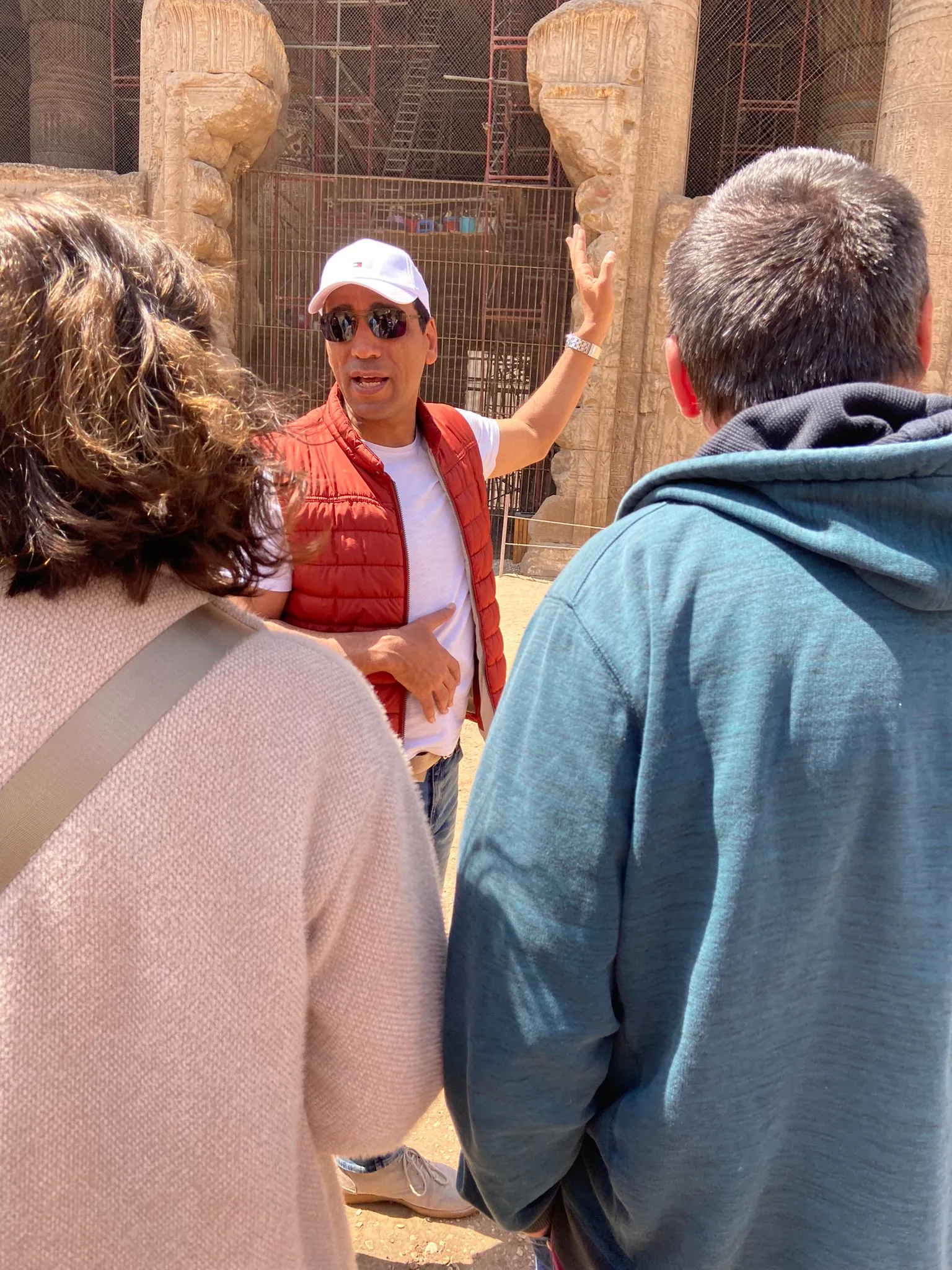
If the decision falls instead on a private tour, the role of the tour guide – in this case, a university-educated, qualified Egyptologist – changes fundamentally. They are no longer the tamer of a crowd but become a personal mentor, an approachable host, and a companion at eye level.
From the very first moment of greeting, a warm, personal contact is established. A private guide has the mental freedom and time to truly get to know their guests. They do not reel off a rigid program but possess the empathy and flexibility to shape the entire daily itinerary 100% according to the wishes and needs of the travelers:
The History Enthusiast: Anyone burning to understand the fine nuances of mythology, read the hieroglyphs on the walls, and know which pharaoh hatched which political intrigue benefits enormously. The Egyptologist notices this immediately. They dive deep into the matter, show details not found in any travel guide, and take exactly the time that the thirst for knowledge demands.
The Hobby Photographer: Anyone looking for the perfect light, the best angle, and above all, a moment when no outside tourists walk through the frame instead of just snapping a quick selfie, is in the right place. The private tour guide adapts to this. They know exactly when the light falls best on which part of the temple, wait patiently, and point out hidden corners for breathtaking, undisturbed shots.
The Relaxed Enjoyer: Perhaps halfway through the day, it becomes clear that the heat is intense or the many impressions are overwhelming. Anyone who prefers to take things a bit slower, sit in the shade of the mighty columns of Karnak, and simply let the spiritual atmosphere of this place sink in, can do so in a private group. The guide senses the energy, adjusts the pace immediately, finds a cool spot, and grants the freedom that is needed.
At the end of the day, it is not just a list of sights checked off. A tailor-made experience has been provided, precisely fitted to the personality. A feeling arises of having seen the country through the eyes of a local – and that exactly is the difference between tourism and real traveling.
Chapter 2: Group Psychology – Shared Harmony vs. Constant Compromise
The Powder Keg of the Heterogeneous Mass
When 50 total strangers are placed in a bus, worlds collide. Sociologically, this is called a heterogeneous group. Here, the newlywed couple on their honeymoon travels next to a family with cranky toddlers. The agile retiree who prepared meticulously sits next to party vacationers who actually just wanted a quick excursion for social media photos.
In such a constellation, conflicts are inevitable. Interests are completely different, leading to permanent, underlying tension. Every decision becomes a flawed compromise. If one half of the group wants to linger longer in the shade of a temple, the other half is already stamping their feet impatiently because they are hungry or want to visit the souvenir shop. Precious vacation time is spent feeling annoyed by the unpunctuality or behavior of other people. The vacation mood is determined not by the beauty of Egypt, but by the weakest link in the group.
The Oasis of the Homogeneous Small Group
A private small group – consisting of a family, a partner, or close friends – is the exact opposite: a homogeneous unit. Everyone knows each other's quirks, shares the same values, and above all, has a common goal for this vacation.
No Social Masks: No one has to pretend or cater to the sensitivities of strangers. If the children need a break, a break is taken without strangers rolling their eyes.
Harmonious Rhythm: Are all members early birds wanting to experience the sunrise at the pyramids? Perfect. Does everyone prefer to sleep an hour longer? That is no problem either.
Shared Joy: An experience becomes all the more beautiful the more intensely it can be shared with the people one loves. Shared awe connects, and the evening conversations revolve around what was experienced, not the annoying seat neighbor from the bus.
Chapter 3: The Invisible Time Thief – How Mass Tourism Destroys Your Vacation Hours
The Honest Accounting of a Bus Tour
Many travelers only calculate the total duration when booking an excursion. A trip from Hurghada to Luxor, for example, is stated as "12 hours." Sounds like a lot of time for culture. But let's look behind the scenes and do a realistic time calculation for a classic bus tour:
Activity on a Large Bus Tour | Time Loss |
|---|---|
Hotel Hopping (Picking up guests at 8-10 hotels) | approx. 1.5 hours |
Biological Breaks (Restroom use for 50 people) | approx. 1.0 hour |
Checking in and out of the bus at each sight | approx. 1.0 hour |
Forced Shopping Stops (Alabaster, perfume, etc.) | approx. 1.5 hours |
Total Invisible Time Loss | approx. 5.0 hours |
In plain English, this means: Out of 12 hours of vacation time, almost half is lost to pure logistics and unwanted coffee shop tours. For the actual world wonders like the Karnak Temple or the Valley of the Kings, often only a stressful 45 minutes per stop remain, during which one is whipped through the sites at a running pace.
The Pure Time Efficiency of the "Speedboat"
The private tour relates to the bus tour like a nimble speedboat to a sluggish oil tanker.
Direct and Punctual: The private chauffeur picks up guests at the hotel exactly at the agreed time. As soon as the car door closes, the journey begins – without detours, without looping through other hotel complexes.
Focus on the Essential: There are no unwanted shopping stops in souvenir factories unless explicitly requested. The time gained flows 100% into the cultural experience.
Self-Determined Pace: If a temple captivates so much that one wants to stay for two hours, then that happens. The time belongs to the travelers. One does not pay for waiting for others, but for one's own pleasure and absolute time efficiency.
Chapter 4: Acoustics and Proximity in Detail – When Culture Becomes a Secret
Lost in the Back Row
Egyptian art is monumental, but its true fascination often lies in the tiny detail. It is the fine, millimeter-defined reliefs on the walls of the Luxor Temple, the thousands-of-years-old color pigments in the burial chambers, or the intricate pieces of jewelry in the Egyptian Museum in Cairo, such as the world-famous golden mask of Tutankhamun.
The Mass Scenario: When a tour guide stands with 50 people in front of such a display case or wall relief, the group inevitably stretches over ten to fifteen meters. Those standing in the back rows physically see absolutely nothing except the backs of other guests' heads. Due to the enormous noise level in the halls and temples, one can also barely understand a word acoustically. The tour guide mutates into a distant silhouette, and the educational vacation becomes a frustrating search game.
Culture to Touch and Understand
In a private small group, history becomes intimate and tangible.
The First Circle: The closed, small group stands directly in front of the object of desire. Every group member has a front-row ringside seat.
Whisper-Quiet Perfection: The Egyptologist does not have to shout over the noise. They can speak in a normal, pleasant conversational volume. Every word, every emphasis, and every historical year can be heard with crystal clarity.
Training the Eye: The guide can point directly to a fine hieroglyph with their pointer stick, and because one stands only a few centimeters away, the symbolism and the story behind it are immediately grasped. Culture changes from a theoretical lecture into a visual adventure.
Chapter 5: Tactical Flexibility in the Temple – How a Speedboat Evades the Tanks
The Inflexibility of the Grey Colossi
Large tour buses move according to a rigid, bureaucratic pattern. They almost all arrive at the major sights at the exact same time because their routes and lunch stops are identically synchronized. This leads to regular shockwaves of tourist crowds. When three buses roll onto the parking lot simultaneously, 150 people abruptly flood the entrance area. Lines jam mercilessly in front of famous photo spots or inside narrow burial chambers. One stands in line, is pushed along, and feels like being at a train station during rush hour.
The Tactical Maneuver of the Private Guide
An experienced private Egyptologist knows the movement patterns of mass tourism inside out. They use this knowledge like a seasoned strategist to secure an undisturbed experience:
The Forward-Looking Eye: If approaching a highlight and the guide sees from afar that a 50-person tour group is currently blocking the view, a bus tour guide would still have to go in because their schedule demands it.
The Clever Hook: The private guide instead turns smilingly with the guests into a quiet, shaded side wing of the temple. They show a hidden but no less fascinating relief there and tell the story behind it.
The Perfect Timing: Twenty minutes later, the large crowd of tourists has left the main highlight again. The group returns there relaxed and suddenly has the magical place almost entirely to themselves. This allows the mysticism of Egypt to be experienced in silence, while the mass is already being rushed to the next stop.
Chapter 6: The Social Dynamics of Asking Questions – Dialogue at Eye Level Instead of Anonymous Pressure
The Fear of Embarrassment in the Crowd
A cultural trip naturally raises questions. One wants to understand connections, draw comparisons to modern times, or simply examine a detail more closely. Yet in large tour groups, a psychological barrier exists that keeps many guests completely silent: the fear of social evaluation.
In an anonymous group of 50 strangers, psychological pressure is high. Many people are shy and prefer to keep their questions to themselves out of fear – they do not want to be seen as "ignorant" or block the already tight tour schedule for everyone else. They go home with unresolved questions. Those who do dare to ask often pose very specific questions that are uninteresting to the rest of the group. This immediately causes restlessness on the bus: people look annoyed at their watches, whisper, or urge to move on. This is a deeply uncomfortable situation for both the inquiring guest and the tour guide.
A Protected Space for Your Thirst for Knowledge
In a private small group, all of this social pressure completely drops away. There are no stupid questions, no false shyness, and above all, no time pressure.
Lively Dialogue: From the very first minute, the atmosphere of a relaxed walk is created. When a thought comes to mind, it is simply spoken out loud.
Interactivity That Enriches: Every question bothers no one, but enriches the experience. The Egyptologist can flexibly veer off-topic, build a bridge to modern times, and dive deeper into exactly those aspects that interest the travelers burning.
Lasting Understanding: Through this genuine exchange at eye level, the knowledge remains in the memory. History is not just passively consumed, but actively thought through and experienced.
Chapter 7: The "Anything Goes, Nothing Concept" Option – Full Freedom During Precious Breaks
The Compulsion of the Organized Mass Break
Particularly during intensive cultural trips that span several hours or days, the breaks between sightseeing are the most important phases for regeneration. One must process the deep, historical impressions, catch one's breath, and gather new strength.
The Reality in Mass Tourism: There is no real recovery here. The group is collectively funneled into huge, noisy contract restaurants. The tables are fixed, one is forced to sit with strangers and engage in small talk even though one is actually just looking for peace. Meanwhile, the tour guide is permanently busy with logistics, bills, and coordinating the bus. A private, deeper conversation is completely impossible in this noise and bustle.
The Absolute Freedom of Choice for the Guest
On a private tour, an iron principle applies: The guest is on vacation and the absolute king. The breaks – whether over a cool drink in the shade of a temple café, a short refreshment in the museum, or during a shared lunch – belong entirely to the travelers. There is absolute freedom of choice as to how this time wants to be spent, completely free of any social compulsion:
Option A: The Desire for Privacy. Do family, partner, or friends prefer to be among themselves during meals? Should private impressions settle undisturbed, photos be sorted on the smartphone, or should everyone just be silent and unwind for an hour? Then this private free space is 100% available. The tour guide will discreetly withdraw, as there is no obligation to engage in a shared table conversation.
Option B: The Desire for Deep Exchange. On the other hand, is there a desire to sit comfortably together over an Egyptian tea or a coffee and chat further? Then this option is open at any time. The Egyptologist can simply be invited to join the table. In this casual atmosphere away from the official program, the most valuable moments of the trip often arise. Here, all the questions can be asked that are not in any travel guide: What is modern family life like in Egypt? How does the school system work? Which traditions are still important to people today?
The guest alone determines the dynamics and the boundaries. Exactly this flexibility and the absence of any compulsion distinguishes a genuine, respectful premium experience from a tightly scheduled, impersonal mass processing.
Conclusion & Summary: Experiences That Stay for a Lifetime
He who buys cheaply often pays with the most valuable asset he possesses: his life and vacation time. A private Egyptian journey in a small group is not a question of luxury or showing off – it is an investment in the quality of memories.
When visiting the massive monuments of the pharaohs, one should not remember the stress on the bus or the loud tour groups. One should remember the moment of standing in complete peace before a thousands-of-years-old wall painting, feeling the warm desert wind, and understanding the words of the personal guide precisely. It is the difference between "simply having been there" and "having truly experienced it deep in the heart."
Discover our completely customized, high-quality private excursions on our English website: Orient Discovery